
Since we wrote our blog post on Parenting Your Right Brain Kinesthetic Learner, Private School Challenges, we have received quite a reaction from parents. Specific reactions included:
- “We appear to have created a “Private School Challenge”. Private schools are becoming much more selective. Is this likely to get better or worse and what can a parent do?”
- “The private school has told me that my child needs to improve their performance to be invited back. They offer in school tutoring. Is that the best option?”
- “Is private school the best option for the bright right brain kinesthetic learner or is public school and investing in private interventions a better option?”
Parenting Your Bright Right Brain Kinesthetic Learner, Why Private Schools are Likely to Become Even More Selective
As we described in our prior blog post, the demand for private schools has increased dramatically as:
- Those parents who are financially able to afford private school, like the option.
- Many families from the Northeast and the Midwest have moved to South Florida. Many are financially stable and like the private school options, thinking they are better educational options.
- Private school vouchers have made private schools affordable for many parents.
- The pandemic made private schools more desirable as they tended to remain open to “in-person” learning. For our Right Brain Kinesthetic learners, this was a huge benefit.
- What is happening in 2023 is likely to accelerate the growth in private school demand as:
-
- Public and charter schools are experiencing more challenges as so many kids are behind as well as a hostile political environment toward public schools.
- School vouchers are likely to be available to many more students.
- More parents want a safer environment with less behavior issues.
Several things a parent can do when considering private school for their child:
- Start your school search early and be aware that your child might not get into your first option, even though you have followed all of the application procedures. Have a Plan B and potentially a Plan C.
- Read any psychoeducational reports carefully before submitting them to a private school.
One case from a family moving from the Northeast, where their daughter had no behavior problems at school, but was a challenge at home, stated the child was “difficult”. The private school rejected their application, citing behavioral challenges that were reported over a year ago. Work with your child’s psychologist to remove red flags, where appropriate. You want to be truthful, and get appropriate help, and professionals can help in this area. If your child is acting out or frustrated, it is often a sign that they are struggling somewhere in the school environment.
- Consider public schools or alternative private schools. There are also new or relatively new private school options that may be an excellent fit.
- Be a collaborative parent – focusing on how you can make it work. In a market where private schools have the upper hand; combative parents will find it hard. We always look for the win-win.
- Private school tutoring may be the right intervention if a child just needs one-on-one help and learns the way the teacher teaches.
For the right brain kinesthetic learner, a tailored outside intervention may be better if they:
- Teach using an engaging, experiential and more effective approach.
- Identify and/or address the relevant executive function issues (e.g., working memory, processing speed and attention issues.
- Help you to be the coach and advocate your child needs.
6. Consider outside interventions. We have helped parents:
- Have their child stay in a very competitive private school by increasing the student’s reading comprehension 3 grade levels in less than a year.
- Have their child go from an expensive academy to a public school the following year and into the gifted program the year after that by significantly improving his reading comprehension and attention.
- Reduce their monthly tutoring costs. A family was spending $750 a month on tutors, and we significantly reduced the amount of tutoring needed, over the years to come, with our program.
The good news is that many bright right brain kinesthetic learners can make significant gains in months.
We offer a no cost conversation to help you navigate these challenging issues. You can arrange a conversation by either:
– Giving us a call at 561-361-7495 or
– Clicking here to Schedule a Conversation

Smart struggling right brain kinesthetic learners in public or a charter school often have:
- A set of strengths that center around imagination, creativity, being visual and learning best when they see and experience information.
- Challenges with reading comprehension and math word problems
- Executive function issues that may include working memory, processing speed and/or attention.
- Auditory and/or visual processing issues.
- They are often frustrated and/or anxious.
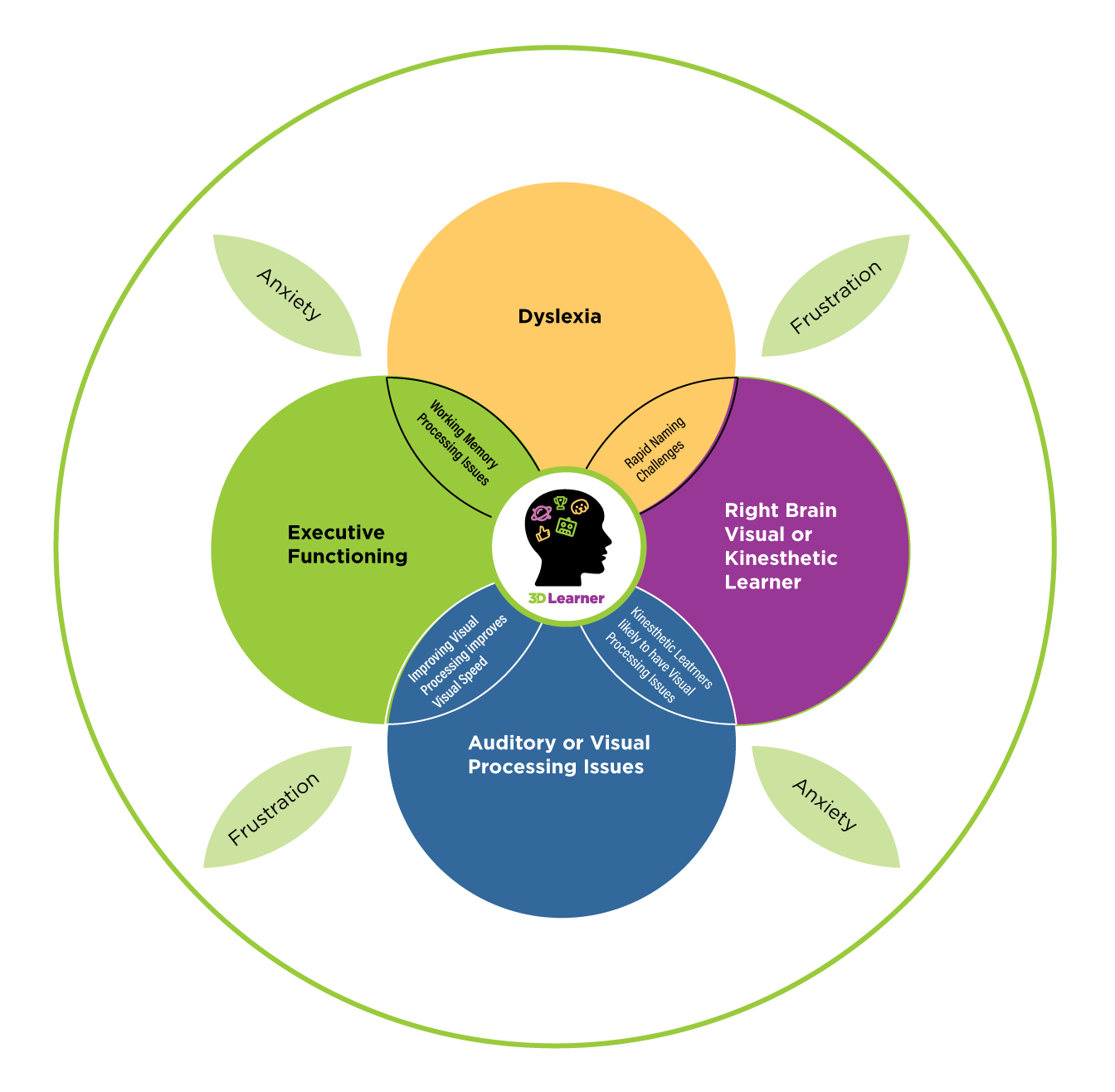
They students are often smart kids who are bright right brain kinesthetic learners with related challenges with significant upside potential.
They also often are not getting all the help they need to succeed for three reasons:
- Public and charter schools are often slow to identify dyslexia or a learning disability.
- Public and charter schools are moving to more and more phonics-based intervention. These teach necessary skills, but often are not sufficient to significantly increase reading comprehension and math levels.
- Most teaching in public and charter schools are not geared to:
- Teach the way a right brain kinesthetic learner learns best.
- Address executive function challenges.
- Address visual processing issues.
- Help a smart struggling child succeed.
A bright right brain kinesthetic learner often has the capability of making significant gains in months with the right outside help.
Consider three examples:
Melissa’s parents were told that third grade retention was a virtual certainty. She was told by a friend to contact us. While she did have a learning disability and dyslexia, she was also a bright right brain kinesthetic learner, who had an attention and working memory issue. Within a few months, she was able to score above grade level in reading comprehension and excel in middle school and beyond.
Alex was a 6th grader. He had never been identified with dyslexia or a learning disability. He had been diagnosed with ADHD. He was inattentive, hyperactive and impulsive. He had been a star baseball player, but now his batting average was down to 250 and he had only hit one home run the previous year. He had also been suspended twice within two months, for minor infractions.
Our assessment showed that Alex was a bright right brain kinesthetic learner; had well above average in intelligence amd had significant challenges with:
- Reading comprehension — both parents were surprised to learn he was 4 years below grade level
- Attention — he could focus for two minutes and then he was gone
- Evaluation skills.
Like many right brain kinesthetic learners he was
- Very creative, both in problem solving and in explaining why he did something wrong
- Prone to make bad decisions
With training, Alex was able to:
- Improve his reading comprehension 4 grade levels within 4 months
- Become an A/B student
- Avoid trouble for years to come
- Improve his baseball results from:
- A 250 batting average to over 400 and lead his team
- 1 to 10 home runs in a season, again leading the team
- See himself as a smart kid who learns differently
James’ parents were really frustrated. As an 8th grader, his reading comprehension was 4 years below grade level, and he avoided reading. By tapping into his strengths and interests and addressing his processing speed, he was able to improve his comprehension 4 grade levels within 4 months, increase his reading speed by 80 percent, excel in high school and earn scholarships to 3 schools.
These students succeeded because their parents chose a path that worked well for their child.
These students are often:
- Far brighter than present results would indicate.
- Bright right brain kinesthetic learners who have not been taught how to leverage their strengths
- Anxious and/or frustrated.
- Likely to not catch up and even more likely to fall further behind their peers — in the last six months.
2023 Challenges Are Larger Than We Have Recently Seen
Recently we have seen:
- 5th, 6th and 7th graders who are 2, 3, 4 and even 5 years below grade level in reading comprehension.
- 2nd, 3rd and 4th graders who are 1. 2 and even 3 years below grade level in reading comprehension
- Math problems, especially math word problems, an even more significant issue
- Anxiety and frustration levels that are far worse than during pre-pandemic years.
In an informal study of educators and psychologists, 3 themes emerged in this post pandemic era:
1–Readers who were above grade level are doing just as well if not better – they appear to have read even more during the pandemic.
2–Students who were on grade level pre-pandemic are at or near grade level.
3–Struggling students:
- Fell even further behind in reading comprehension.
- Are often even further behind in math – where prior year’s struggles make the next year much harder.
5 Steps to Help Your Bright Right Brain Kinesthetic Learner Succeed
STEP 1
Reject the status quo and focus on how your child can make significant gains within months.
STEP 2
Work with someone who can identify your child’s:
- Strengths
- Challenges
- Present Level of Performance
⇒⇒ Note, while many assessments focus on labels like dyslexia, learning disabilities, or ADHD, we have found it very helpful to assess for:
- Whether your child is a right brain and/or kinesthetic learner
- Various processing issues that include:
- Working memory
- Processing speed
- Attention
- Auditory processing
- Visual processing issues that are often missed
- Present levels of performance — especially for reading comprehension
STEP 3
Set BOLD Goals. These might include:
- Improving your child’s reading comprehension by 2 or more grade levels within 6 months
- Getting your child back to grade level in math
- Cutting homework time by 33%. For a child taking 3 hours to do homework each night, this could save each of you 5 hours a week and 100 hours over the next 20 week
- Improving their working memory and attention
- Boosting their self-esteem
STEP 4
Partner with an educator who can help:
- Your child achieve their goals
- You to be the coach and advocate your child needs
- Help you navigate the parent – – school connection to get the support your child needs
STEP 5
Be focused on the goals and open on the how
Public and Charter Schools often do not have programs that capitalize on a child’s strengths, identify and address their challenges, or help your child make significant gains within months.
If you have a bright right brain kinesthetic learner, or you just want a no cost conversation;
Call us at 561-361-7495 or
Click here to schedule a Stress to Success Conversation
Background on How We Learned About The Right Brain Kinesthetic Learner. We had tried various reading comprehension programs, dyslexia treatments and tutors. It was not until I learned about the right brain kinesthetic learner, that I developed the 3D Learner Program ® that helped my daughter to improve her reading comprehension 4.2 grade levels in 7 months and to become the teacher she never had.
3 things we know about these bright right brain kinesthetic learners:
- They can often struggle for years
- They can often become far more successful in all aspects of life
- They are 100 percent dependent on their parents finding the right help
Be the Parent Who Makes The Difference, Especially If Your Child is a Bright Right Brain Kinesthetic Learner with Significant Upside Potential
If you have a bright right brain kinesthetic learner, or you just want a no cost conversation;
Call us at 561-361-7495 or
Click here to schedule a Stress to Success Conversation

Parenting a bright right brain kinesthetic learner has been made more challenging as the request for private school slots exceeds availability. With a new Florida Law likely to provide private school vouchers for many more students, we expect private school demand to accelerate for the 2023-24 school year and beyond.
In this blog post, we will cover 3 scenarios where parenting a bright right brain kinesthetic learner has gotten harder, why it will get worse and what parents can do about it.
Given the very competitive nature of private schools, as a parent, you may find yourself wanting some help. We are only a phone call away. We have helped many parents navigate through some tough challenges, and best of all, we have helped many students do far better in private schools than others thought possible.
Consider how much different your child’s live would be when:
- Your child is doing far better in school.
- Your child’s self-esteem is much higher, and their anxiety is much lower.
- Their reading comprehension is 2 years better than it is now.
- Math is now a strength and math homework takes much less time and is done right.
- They are performing much better in a non-academic effort – karate, sports, music etc.
- Your anxiety and frustration is much lower.
For a no cost Private School Conversation, either:
– Call us at 561-361-7495
– Click here to schedule a Conversation
What is a Bright Right Brain Kinesthetic Learner
It’s important that we understand that we all have different strengths and areas that need strengthening. We DO learn differently, and although we need to learn using all modalities, when a child is struggling, it is important that learning is targeting a child’s strengths. A student who learns best when he or she sees and experiences information is how we characterize a BRIGHT Right BRAIN KINESTHETIC LEARNER. They often learn best when they can discover patterns and do far better with experiential learning that combines visual, kinesthetic and engaging strategies.
These students often struggle with:
- Reading comprehension and math, especially word problems
- Executive function issues (e.g., working memory, processing speed and attention)
- Auditory or Visual processing issues
These bright right brain kinesthetic learners face several challenges that make private schools challenging:
- They are often a lot smarter than their reading comprehension or math skills would indicate.
- Private schools often rely on entrance exams that are difficult for these students to pass-they are very “wordy”!
- Private school curriculums are often a year ahead of the public school’s curriculum. For a student who is a year or two below grade level, this puts them two or three years below what is expected.
- Many private schools are now offering expensive tutoring that schools may require, but they may not be what your child needs. Understanding HOW your child learns, is vital.
With Help, Many Bright Right Brain Kinesthetic Learners Can Succeed
Michael’s parents were furious. Despite a 132 IQ, the psychologist had recommended her son not go to a rigorous private school. He recommended another year of phonics-based training and that the parents enroll Michael in a school for students with learning disabilities and dyslexia. Looking at the two dyslexia treatments that were recommended, mom asked the psychologist, “Is there a third option that teaches the way my son learns?”.
He referred them to 3D Learner. Mom called us from the psychologist’s parking lot.
The first three questions piqued mom’s interests:
- Does your child remember places visited, even from years ago?
- Does your child learn best when he sees and experiences information?
- Is your child a lot smarter than present results would indicate?
It turns out Michael was a bright right brain kinesthetic learner with working memory and processing speed issues. We were able to significantly improve his reading comprehension, executive function skills and his confidence. Note, many right brain kinesthetic learners have excellent memories for what they see and experience, but not for what they read or hear. They are processing a great deal of information, but their visual processing issues often slows down their reading.
Michael did much better from day one, and he got into the rigorous private school and even better …
The young man graduated high school near the top of his class and later graduated from MIT.
⇒ All because mom decided to pursue a strength-based option for learning.
Her comment was, “You changed his attitude about himself and that was 90 percent of the battle”. KF Parkland, FL
For a no cost Private School Conversation, either:
– Call us at 561-361-7495
– Click here to schedule a Conversation
The Bright Right Brain Kinesthetic Learner Struggling to Keep Up
Sarah was struggling to keep up. The school recommended grade retention. When the parents rejected that, tutoring was recommended. Again, not consistent with what this bright right brain kinesthetic learner needed. Mom called a friend and described her challenge. The friend said, “I cannot help you, but I think Denise can”. Mom then called Denise and after an hour, they realized that both had smart kids who learned differently. Mom called and they came for the 3D Learner Program ®. Sarah was initially the lowest reader in her class and she avoided reading. By the next school year, she was at the top of her class in reading comprehension and the most avid reader. In a month-long competition, the average student read 180 pages, her best friend read 360 pages; Sarah read 720 pages. When asked why she now loved reading, Sarah said, “3D Learner taught me how to create videos and visuals for what I read, do you know how cool that is?”
The parents commented, “You showed us our daughter’s gifts, and helped transform her into an outrageously successful student” Mr and Mrs R, Florida
For a no cost Private School Conversation, either:
– Call us at 561-361-7495
– Click here to schedule a Conversation
⇒ All because a mom and dad chose to take the path less traveled.
The Student Who Is Doing OK, Can Often Excel, and Parents Are Not Aware Their Child is a Bright Right Brain Kinesthetic Learner
Parents are often baffled by the challenges their child faces. Many parents of bright right brain kinesthetic learners are not aware of their child’s strengths. Mary was visiting a friend, whose dyslexic son had been struggling in school. Mary and her friend were sitting in the kitchen when the young man walked into the living room with a book and devoured it. Mary asked, “What happened? Jake never read like that before.
Mom indicated they had come to us. Mary asked, “Does 3D Learner help kids who do not have dyslexia, are doing OK, but have the potential to do far better?” Her friend answered, “Yes, they do”. They help students who are creative and learn differently. Give them a call.”
Mary did and her daughter blossomed after our training. She went from a C- student to an A student and her confidence soared.
For a no cost Private School Conversation, either:
– Call us at 561-361-7495
– Click here to schedule a Conversation
Some Private Schools Are Not Right for Certain Right Brain Kinesthetic Learners
We have had cases where a school was not the right fit for a child. This is especially true when the school caters to the very bright and often gifted, high achieving students, and the student in question has a below average IQ.
Nancy had a case like this with her third child Max. Her other two children were well suited to this highly competitive school, but Max was not. In this case, we worked with the parents to find the right school. Since there was no room for the balance of the school year at the new school, we worked out a win-win situation where Max could stay at his present school, and we would supplement his education.
Bright Right Brain Kinesthetic Learners Can Often Excel, with the Right Help
If your child is facing challenges with a private school, consider four things:
- Is your child a lot smarter than present results would indicate?
- Might your child be a bright right brain kinesthetic learner, who would benefit from a different approach?
- Would you like to know how your child can make significant gains in months
- Would you like help from a Parenting Guide, who specializes in helping Parents to Navigate the Private School Puzzle.
Note, while the majority of our students are bright right brain kinesthetic learners, we also help students with executive function and related challenges
For a no cost Private School Conversation, either:
– Call us at 561-361-7495
– Click here to schedule a Conversation
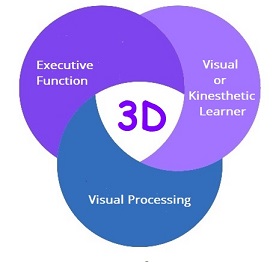
Many smart struggling students are either a Kinesthetic Learner, have Executive Function challenges and/or have a Visual Processing issue.
Is your child a visual or kinesthetic learner with executive function &/or a visual processing challenge?
Our comprehensive assessment process is designed to tailor a solution to meet your needs
Three key differences to take note of in 2022 – 23 school year:
- Reading comprehension and math gaps are wider than in prior years. Math is now the most common issue. Math word problems are often a huge problem for an older kinesthetic learner.
- Executive function and visual processing issues are even more common and more severe
- Anxiety and frustration are much bigger issues
7 Ways The 3D Learner Assessment is different than most:
1- Our end goal is to tailor a program to help your child succeed.
2- We identify your child strengths and how to use them in creating a program
3- We identify the key executive function issues that often hold a student back. These may include attention, working memory, processing speed, etc.)
4- We assess for a visual processing issue. For local clients, we use a Visagraph ® that shows you exactly how your child’s eyes track when reading
5- We assess for your child’s present level of reading comprehension, and we assess their writing skills
6- We identify key learning strengths and challenges. The strengths often boost a student’s self-esteem and show potential. The challenges show us where improvement is needed.
7- We tailor a program to meet your child’s needs and your goals.
We also recognize that anxiety is a major issue and …
3D Learner is now offering the Safe and Sound Protocol ® at no cost
for those investing in a Comprehensive Assessment by September 30th
Call 561-361-7495 or click here to book an Assess for Success conversation
Note, the 3D Learner assessments can be done remotely via zoom or at our Coral Springs office. The only difference is we cannot do the Visagraph ®, that shows visual tracking, and the Interactive Metronome ®, that assesses for attention challenges, remotely,
As a transformational learning center, we use the assessment process to tailor solutions to meet our students’ needs. Most parents are frustrated that their child struggles with 3, 4, 5, 6 or all 7 of the following challenges:
- They are a lot smarter than their present level of reading comprehension would indicate
- Math may be an issue, but math word problems are almost always an issue
- Putting their thoughts on paper and/or handwriting Their child may be able to hyperfocus on video games, Legos or science, but their child often has difficulty paying attention to that which is boring. A fraction of our students have ADHD, Attention Deficit and Hyperactivity Disorder), others have an attention issue, and others do not
- Spelling, remembering math facts and remembering simple auditory instructions is a challenge. This is often called working memory
- Their child reads and may respond slower than one would expect — processing speed. People do not realize this is often caused by a visual processing challenge
- Anxiety and frustration are all too common
Why We Assess for How Your Child Learns Best,
Executive Function, Visual Processing and other Challenges
Most smart struggling students learn best when they see and experience information. We call this student a kinesthetic learner. Others may call them a right brain or visual learner. These students often struggle more than their more logical, sequential and auditory peers with remembering words seen and not mastered, not understanding high frequency words and with visual processing issues. That is, they often have better peripheral vision, but they often skip words and lines when reading.
They also do far better with reading comprehension and with math with kinesthetic learning. They find the work more engaging, it leverages their visual memory, and we make it more relevant.
Our comprehensive assessment includes:
– The Structure of Intellect Assessment ® that identifies:
– How your child learns best
– Your child’s strengths and challenges
– Whether there appears to be a visual or auditory processing issues
One principal at a school in Boca Raton asked her special education specialist during an IEP meeting, why they stopped using this assessment. The ESE specialist said the assessment was great because it identified how a child learned best and their strengths and challenges. She then added that the Federal Government requires public schools to focus on a label,(in order to get program funding) and the SOI does not do that. She then added, that 3D Learner has the luxury of using this assessment because they are primarily interested in tailoring a program to help a student succeed
The Mindprint Assessment(R) that assesses Executive Function and identifies strengths and weaknesses for:
- Working Memory
- Processing Speed
- Attention
- Flexible Thinking
- Abstract Reasoning
- Spatial Perception
- Verbal Reasoning
- Verbal Memory
The MindPrint cognitive screener was developed by neuroscientists at University of Pennsylvania’s Perelman School of Medicine through a National Institutes of Health grant. This online assessment is so reliable and efficient NASA uses it to test the astronauts during long-duration space flights. It is an excellent assessment, and where help is needed, we can provide it with the Brainware Safari Program ®, the Interactive Metronome ® and the core 3D Learner Program ®
For local clients, we use a Visagraph that shows how a student’s eyes track when reading. Click here to see how a student’s eyes tracked before and after our program.
We use the Interactive Metronome ® to assess for attention.
We do a Woodcock Johnson Reading Comprehension ® assessment.
3D Learner is now offering the Safe and Sound Protocol at no cost for those investing in a Comprehensive Assessment by September 30th
Call 561-361-7495 or click here to book an Assess for Success conversation
Our expertise is with the right brain, visual or kinesthetic learners who often have executive function issues. These students often have visual processing issues, too. That is, they skip words and lines when reading and/or make mistakes when doing math work because of visual challenges.
The Visual or Kinesthetic Learner often has Executive Function Issues and
Frequently Has a Visual Processing Issue,
is Often Far Behind and has the
Potential to Make Significant Gains in Months Not Years
As you read this blog post, you may well conclude that your child probably:
- Is a right brain, visual or kinesthetic learner
- Has some combination of executive function (e.g. working memory, processing speed, attention etc..) and/or visual processing issues.
- Is a lot smarter than present results would indicate
If you would like to learn more about how you can make the difference for your child, we are offering four options:
- An assessment special between now and September 30th. Those investing in a Comprehension Assessment will receive – at no cost – the Safe and Sound Protocol Program, a therapeutic service that will help calm your child and yourself
This blog post is written for parents of students in grades K to 12. All these students lost precious in-class time, and far too many are much further behind than they otherwise would have been, especially in reading comprehension and math. Some of our students know their math facts, but almost all struggle with math word problems.
Some key points about the recent NAEP Report,
- The NAEP (National Assessment of Educational Progress) scores for reading comprehension and math show a significant decline. Consistent with what we would expect, the struggling learners lost 5 times as much ground as their high performing peers (i.e. the struggling learner on average lost close to 1 year’s learning during the pandemic). As a parent, if you have a child who is struggling with reading comprehension and/or math, we believe it is critical to check with their teacher on your child’s present level of performance for both reading comprehension and math. Note, be careful on reading comprehension. Schools often use reading fluency, how well a student reads out loud instead of reading comprehension. We have seen cases where:
- A fifth grader read on the 5th grade level, but his reading comprehension was at the 1st grade level
- A 10th grader read on the 9th grade level, but his reading comprehension was at the 2nd grade level.
Discrepancies like this are far more common now, with the focus on reading fluency vs reading comprehension. For the kinesthetic learner with executive function and/or visual processing issues, reading comprehension and math word problems are two of the key issues.
NAEP Reading comprehension and math scores were released on September 1st, 2022. NAEP is the biannual National Assessment of Education. The key point to note is that the struggling learners lost 5 times as much as the students in the top 10%. A 10 point drop vs a 2 point drop. This is consistent with what we are seeing for our students who tend to be a kinesthetic learner with executive function issues.

The Kinesthetic Learner with Executive Function Issues Often Struggles More Than Most with Reading Comprehension and Math, Especially Math Word Problems
This is a four part series to transform Stress to Transform Stress to Outrageous Success for the Kinesthetic Learner with Executive Function challenges. The blog posts will focus on 4th graders and above. The reason is they had some of their education prior to school closings, their education was disrupted, and now issues may now be surfacing.
1- Who is the kinesthetic learner and how Executive Function issues are often present. The kinesthetic learner learns best when they see and experience information, have executive function issues (e.g. working memory, processing speed, attention etc.) and they often have visual processing issues. The question are
Is your child a visual or kinesthetic learner?
What is your child’s present level of reading comprehension and math. Note a number of students we have seen this year were doing quite well before COVID but are now both struggling, and many have a negative attitude, especially in math.
What is your child’s school saying
What are the common problems a visual or kinesthetic learner with executive function and/or visual processing issues may have
What would we recommend parents first steps be
2- Assessing for Success for Your Child who may be a Kinesthetic Learner with Executive Function and related issues. Why it is important to:
- Get the right assessment from your child’s school – recognizing the value and limitations of a school-based assessment
- Finding the right outside professional to help you identify how your child learns best and identifying their challenges
- Recognizing the value of the outside assessment comes in the right assessment, recommendations and referral to the right outside professionals
3- Choosing the right professional for your child and you. Student and parenting training the kinesthetic learner with executive function issues are both needed
4- The keys to transform stress to outrageous success during and after training.
The Kinesthetic Learner with Executive Function and Visual Processing Issue
10 Strengths and Challenges Your Child May Have

Note, if these characteristics describe your child, they may be a kinesthetic learner with executive function and/or visual processing issues.
Speaking With Your Child’s Teacher or School Official
Five things you might want to ask:
– What is your child’s present level of reading comprehension and if they mention reading fluency, say I want both my child’s present level of reading fluency and reading comprehension
– How is my child doing in math, especially on math word problems
– Where is my child really doing well? Great for speaking with your child
– Where else is my child struggling?
– What is or could be done to help my child?
Note, too often a parent may hear that their child is struggling, but so are many others. We know that schools are overwhelmed with the number of struggling students. Too many will struggle for years to come.
We recommend parents be Informed, Empowered and Proactive Parents to help your child succeed. Specifically, we recommend:
1- Get as much help from your child’s school as possible
2- Assess to see if your child is a kinesthetic learner, and whether they have executive function and/or visual processing issues, looks for other conditions and what is their present level of performance for reading comprehension
3- Partner with professionals who can provide the help your child needs and who can help you to be the coach and advocate your child needs
Note, if your child is a kinesthetic learner with executive function issues, they may be a lot smarter than present results would indicate. Commit to helping your child to be all they can be.
If would like to learn more about how you can make the difference for your child, we are offering four things:
A no cost “How to Close the Gap conversation” you can have
by either calling us at 561-361-7495 or by
clicking here to schedule a “How to Close the Gap conversation”
An assessment special between now and September 30th
where those investing in a Comprehension Assessment will get the
Safe and Sound Protocol
a service that will help calm your child and yourself
– Weekly Facebook lives at 9 pm on Tuesday night
Recent Comments