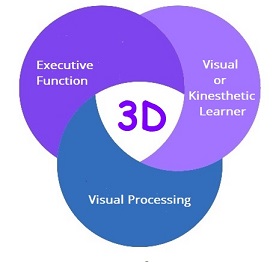
For Your Kinesthetic Learner with Executive Function and/or Visual Processing Issues
How to Help Your Child Succeed
(Assessment Special at the Bottom of the Page)
Most students we see are a kinesthetic learner with some executive function issues. They often have visual processing issues. Frustration and anxiety appear to be impacting these students even more than others.
This blog post is focused on how you, as a parent can:
- Stabilize the situation now. We are seeing large numbers of kinesthetic learners with frustration and anxiety issue
- Get help from your child’s teacher to do the same
- Start the investigation process to consider what else needs to be done
- Do the same process with their school
- Take control of the process and look for a program that assesses and addresses the Whole Child — with a focus on your child’s strengths and challenges.
7 Key Points About the Kinesthetic Learner with Executive Function and/or Visual Processing issues
- The kinesthetic learner learns best when he or she sees and experiences information. Too many words often overwhelm them. Keep instructions visual and use a few words — focused on what you want them to do and why
- Working memory and/or processing issues are often challenges. Checklists and visual schedules really help. Psycho-education evaluations often identify these issues.
- Visual processing is a very common challenge for the kinesthetic learner. The kinesthetic learner often has better peripheral vision and their eyes are often scanning the environment. The kinesthetic learner often skips words and lines when reading and/or has problems copying off the board.
- Anxiety and frustration are often present. As parents, we recommend you:
-
- Stay calm. Nothing reduces stress and anxiety quicker than a calm parent
- Use checklists and visual schedules
At a quiet moment, ask your child:
-
- What are you enjoying about school
- What is causing you any stress or anxiety
- How can we help
Share the relevant information with their teacher
-
- Where your child is strong
- Where they tend to struggle
- What small changes might make big differences
- Ask them if they are seeing the same thing or something different
- Ask them if they have your child’s present level of performance on reading comprehension and math and if not, when might they have it. In Florida, public schools are required to complete their first round of assessments by September 30th. They are now required to share that with parents
We have an excellent system that reduces stress and anxiety called the Safe and Sound Protocol. This is normally a $300 investment. For those parents investing in our Comprehensive Assessment for your child by September 16th, we will be including the Safe and Sound Protocol at no extra cost
To start the conversation, either call us at 561-361-7495 or
click here to schedule a Conversation on How to Help Your Child Succeed
- Use the next few weeks to initiate action where needed and to investigate the following:
-
- Schools are often slow to assess a child for a learning disability, dyslexia or some other learning problem. If you think your child needs to be assessed, we encourage you to initiate the process ASAP. . Schools will often tell a parent, “We do things sequentially. We need to initiate either RTI or MTSS (Response to Intervention or Multi-Tiered System of Supports), before we assess. The Federal Government has issued guidance that RTI Cannot Be Used to Delay or Deny an Evaluation. If this is an issue, we recommend you visit our webpage www.3dlearner.com/rti-mtss where we provide a link to the letter from the Office of Special Education Programs and a sample letter you might share with their school.
- The single most important point for the kinesthetic learner with executive function and/or visual processing issues is that neither schools nor most programs identify or address the whole child. Specifically:
-
- Schools do not often assess a child’s learning style.
- Executive function issues are often identified, but rarely addressed
- Visual processing issues are often missed and rarely addressed
- Anxiety, attention and frustration are often left to the psychologist and/or the parent, when there are natural and effective ways to address them
- Parent coaching is rarely addressed, and it can be incredibly helpful
At 3D Learner, we recognize the need for:
- An assessment that focuses on the Whole Child
- Training that teaches the way a right brain, visual or kinesthetic learner learns
- Addressing the executive function issues as part of an integrated program
- Identifying and addressing the relevant issues
- A solution that will lead to significant gains within months
- Combining a program that offers
- Immediate benefits
- Provides an Assessment for Success
- Offers a program that can be tailored to your child’s needs
- Provides you with the tools and processes to be the parent your child needs
Comprehensive Assessment Special
For those parents investing in our Comprehensive Assessment before September 16th we are offering:
Our comprehensive assessment that includes:
- The Structure of Intellect Assessment ® that identifies:
-How your child learns best
– heir strengths and challenges
-Whether there appears to be a visual processing issue
-Your child’s present level of performance
- The MindPrint Assessment ®
–An executive function assessment for students 8 and older
- For local students, in our office
-A Visagraph ® assessment that shows how your child’s eyes track when reading
–The Interactive Metronome ® that assesses for attention, impulsivity and neural timing
If you have a smart struggling child who might be a kinesthetic learner with executive function and/or visual processing issues, we suggest you
Start the conversation, by either calling us at 561-361-7495 or click here
to schedule a Conversation on How to Help Your Child Succeed

Bright, creative kids with learning difficulties may underperform at school. They know they’re smart but somehow they can’t quite understand what the teacher is explaining. What is important to understand is that these right brain children often struggle with reading comprehension, math, and executive functioning. It is not because of their ability. It’s because they are right-brain learners trying to make their way in left-brained classrooms.
These struggles lead to frustration, a loss of confidence, and difficulties in school. Yet all the while, you know you have a bright, creative child.
We help parents end the cycle of frustrations
After working with thousands of students, we know that concerned parents can make a difference by using a strength-based parenting approach to your child reach their full potential.
Strength-based parenting starts with the question “What is right with my child?” It is a parenting style that builds up strengths and assets before it seeks to address problems and weaknesses.
Strength-based parenting is not about ignoring or unrealistically turning a blind eye to the downsides; it’s about where you place your attention first. When you focus on strengths before weaknesses, you can help your kids use what they’re good at to overcome their learning difficulties.
How many of these strengths does your child possess?
Here are twelve strengths we often find in the bright right-brain learner. How many does your child demonstrate?
Strengths of right-brain learners
- Learns best when they see and experience information
- Good problem solver
- Creative and comes up with new ways to do things
- Observant
- High levels of empathy – they often relate well to small children animals, older adults
- Excellent big picture thinkers
- Good at making connections
- Strong narrative reasoning
- Three-dimensional thinking
- Respond well when their questions are answered
- Work best when the work is relevant and interesting to them
- Able to excel when they are taught in a way that is strength-based and engaging and their challenges are addressed
What challenges is your child facing?
Here are some of the usual learning issues right-brained issues manifest. They become much easier to overcome when you use your child’s strengths as a launchpad for success.
- Difficulty learning and remembering high frequency or sight words — that do not generate a picture
- May not recognize words they have seen before and not mastered – their working memory is often weak
- Get overwhelmed with too many words
- Often struggle with logical, sequential, and auditory programs
- Do not respond well to people who talk down to them or do not understand them
- Can respond negatively to facial expressions or what they perceive as the wrong tone of voice
- Language — they have often not developed vocabulary, since they avoid reading
- Often skip words and lines when reading
- Their memory for what they hear or read is often weak — sometimes called working memory
- May struggle to pay attention when the work is boring or frustrating
- May be very anxious or frustrated
- Silent reading comprehension is often very difficult for these students
If you want to take more time to assess your child, call us at 561-361-7495
Right brain learners can often be quite articulate – and clever – about the disconnect between what you are saying and what they are thinking.
Some of the things kids say that are often clues about their learning needs (and how clever they may be) include.
- I’m not stubborn….. I’m thinking about the picture in my head
- I’m not losing focus….. I just don’t understand anything you are saying
- I’m not bossy…. I’m just telling you the way I would do this
- I’m not lost… I just found a different way to go
- I’m not mad…. I just don’t know what words to use when I’m frustrated
- I don’t know HOW to Do this problem… BUT I’m very good at thinking of ways to get away from it
What can you do to help?
Dealing with a learning difference begins with open, non-judgmental communication. Sit down with your child and your spouse and discuss the list of strengths and challenges. Observe your children to identify strengths and weaknesses in their learning styles.
Also, think about the times your child enjoys learning. Do they have specific interests that really excite them, subjects that they just can’t learn enough about? What do you think made those moments so educational for your child? Was it a hands-on experience giving them items to touch? Was it driven by words or by pictures?
A strength-based approach to education uses your child’s natural strengths and interests to inspire learning of all types. Such an approach effectively engages children and their successes and enjoyment in turn lowering anxiety and building self-esteem. Best of all, once your child has renewed confidence and new learning strategies, school becomes a place of learning, not frustration.
If you would like to have a conversation on your child’s strengths, challenges, and how you can make the difference, call us at 561-361-7495 or book a time here.

Third Grade Retention is a major issue in Florida. This blog post is written specifically for Florida, but many of the points may be applicable elsewhere. What differentiates 3D Learner from others is:
- We have seen the third grade retention risk be the catalyst for parental action that significantly improved their child’s reading comprehension and igniting a love for learning, while reducing anxiety
- Virtually every third grader we help gets promoted and enters fourth grade far better prepared to succeed
- We understand the system and will provide you with the best possible advice
- Our initial goal is to help parents to understand why your child is struggling, how they can succeed and how you can make the difference
- Our long term goal for those who chose to work with us is to:
- Significantly improve your child’s reading comprehension
- Ignite a love for reading and learning
- Identify and address the relevant:
- Working memory, processing speed and/or attention challenges – these are often referred to as executive function issues
- Visual processing, motor planning and/or anxiety issues
- Help you with school choice decisions and to get the best possible help from your child’s school
- Help you to be the coach and advocate your child needs
Several key points to consider before making a decision about third grade retention or other options:
- We recommend talking with your child’s teacher. They may already have gotten your child to the point where they can be promoted or they can share their perspective
- Private school or home school options rarely address the underlying reading comprehension, executive function, visual processing and/or related issues.
- Your child may not be ready for 4th grader yet and you may want to …
- Consider an outside intervention. Even if you are considering private or homeschool options, the right intervention can prepare your child for success in 4th grade and beyond
A parent or professional can contact us for a no cost Beat Third Grade Retention conversation
Call us at 561-361-7495 or
Find a mutually agreeable time on our schedule by clicking on our
Beat Third Grade Retention conversation
Many students at risk for third-grade retention are a Right Brain Learner with Executive Function, Visual Processing and related challenges.
A child who scored a Level 1 on the third grade English Language Assessment and if facing third grade retention, often is:
- A right brain learner, who learns best when he or she sees and experiences information. This is not the way schools tend to teach and the right brain learner is often far smarter than their present level of reading comprehension would indicate
- Struggling with Executive Function challenges. These might include problems with working memory, processing speed and/or attention
- –Skipping words and lines when reading — what we call visual processing issues

At 3D Learner, we have helped many students to beat third grade retention by:
- Teaching the way the student learns best
- Identifying and addressing their executive function, visual processing and/or related challenges
- Significantly improving their reading comprehension and igniting a love for learning
Most students at risk for third-grade retention are 1.5 to 2 years below grade level in reading comprehension. To beat third-grade retention and prepare your child for Fourth Grade Success, it is critical to improve your child’s reading comprehension.
Note: 3D Learner has helped many students make significant gains to both beat third grade retention and to be far better prepared for 4th grade and beyond.
A couple of examples of our student’s progress:
- A student got a Level 1 on the Third Grade English Language Assessment and with our help he got a Level 4, above grade level score, on his 4th grade English Language Assessment
- Another student improved his reading comprehension three grade levels between third and fourth grade and his teacher said, “Thomas made more progress than any student I have had in 27 years of teaching”.
A parent or professional can contact us for a no cost Beat Third Grade Retention conversation
Call us at 561-361-7495 or
Find a mutually agreeable time on our schedule by clicking on our
Beat Third Grade Retention conversation
Recent Comments