
Right brain kinesthetic learners face huge risks this school year. Many teachers will be new, schools may be understaffed, and special educators may be overwhelmed. In this blog, we will discuss:
– How to expedite a special education evaluation
– Why and how to improve an IEP
– Why more may be necessary to have your child reach his or her potential.
Note, many public and charter schools have invested in dyslexia treatments. This will help student’s reading fluency, but it often does not significantly improve reading comprehension.
We have had parents who asked their child’s school to evaluate their child for special education services. We have heard many excuses, with the most common being, we need to complete the RTI or Response to Intervention Process first — some schools now refer to this as MTSS, or Multi-tiered System of Support.
This is not acceptable. Back in 2011, Dr. Melody Musgrove, the Federal Director of the Office of Special Education Programs, developed a policy that “RTI Cannot Be Used to Delay or Deny an Evaluation”. Click on this link and you will get a more in-depth discussion of this issue, a copy of Dr. Musgrove’s letter. RTI Cannot Be Used to Delay or Deny an Evaluation “. Here is a link to a sample letter you can tailor to your situation. We have used this hundreds of times and it works virtually every time. Mary used this note and made sure to give her informed consent for an evaluation. It was approved 1 week later, the evaluation was completed, and an IEP was developed within 60 days. It is doable.
Most Individualized Education Plans or IEPs we read anger us. There has been a trend to focus on reading fluency, how well a student reads out loud, and even when there are reading comprehension goals, they rarely close the gap.
Let’s take the case of Alex. He was a 6th grader. His IEP said he was reading at the 5th grade level. His homework, which should have been taking an hour, was now taking 3 hours and sometimes more.
When we assessed his reading comprehension, we found his reading comprehension was at the 3rd grade level. For comprehension, his goal was to answer who, what, where, why and how questions correctly 4 out of 5 times at his independent reading level.
Mom asked for an interim IEP meeting and asked the school to evaluate his reading fluency and his reading comprehension. The school assessment showed his reading fluency and reading comprehension were at the 5th and 3rd grade levels respectively. Mom got an interim IEP and they adjusted his reading comprehension goal to make 1.5 grade level improvement in a year.
For The Right Brain Kinesthetic Learner, Schools Rarely Address 5 Key Issues
While reading fluency has gotten a great deal of attention with the focus on dyslexia, 3 issues that are often not addressed in a comprehensive way include:
- Reading comprehension. Note, if a student is 3 years below grade level and over the next year they improve their reading comprehension 1.5 grade levels, they will still be 2.5 years below grade level.
- Vocabulary. The right brain kinesthetic learner often does not master vocabulary the way schools teach. Looking up the definition, writing the word and using flash cards to master the words rarely helps the right brain kinesthetic learner.
- Executive function issues are often identified but not addressed. We have seen students who have IEPs for years where.
- Attention continues to be a major issue
- They have an excellent visual memory, but have great difficulty remembering what they hear or read
- They read very slowly
- Visual processing issues often get worse as the words get smaller. This may result in skipping words and lines when reading, making careless mistakes in math and having difficulty copying off the board.
- Too often the right brain kinesthetic learners are both frustrated and anxious.
At 3D Learner, our goals often include:
- Targeted efforts to improve reading fluency, based on the specific needs of a student.
- Improving reading comprehension by 2, 3 and even 4 grade levels within 4 to 6 months.
- Significantly improving vocabulary, first with a focus on the small words that often confuse a right brain kinesthetic learner.
- Identifying and addressing the relevant executive function and/or visual processing issues.
- Lowering anxiety and frustration, while boosting self-confidence.
If we can help in any way, call us at 561-361-7495 or click here to schedule a conversation.
(Strength based training and strength based parenting works for these students)
We focus on how parents can take charge and help your right brain kinesthetic learner succeed. Note, most smart struggling students are right brain kinesthetic learners, who learn best when they see and experience information. When we were told our 8th grade daughter was not college material, I became a mom on a mission. I leveraged my educational and parenting skills and developed what has become the 3D Learner Program ®. With the program, she was able to improve:
- Her reading comprehension 4.2 grade levels in 7 months
- Her Grade Point Average from a 2.7 to a 4.4
- Chances for success. She got her Master’s in Education from the University of Florida. Next year will be her 19th year of teaching and in May 2024 she should be receiving her Doctorate in Education from the University of Florida.
Many of our students are bright right brain kinesthetic learners, who often struggle with:
- Reading comprehension — just this year we have had 6th and 7th graders who were 3, 4 and even 5 years below grade level
- Reading speed — too often students read so slowly that it is hard to sustain attention
- Math word problems
- Putting their thoughts on paper
- Being in classes with kids who are not motivated
For the purposes of this blog post, we will define success for these students as:
- Being on grade level for reading speed
- Reading comprehension two, three or four grade levels higher than their present level
- Being able to get a B or better in math, learn how to check their work and start to like math
- Both mastering math facts and being good at math word problems
- Writing at least at grade level
- Being able to do their homework more independently in much less time
- Now being placed in advanced or gifted classes, where they are far more engaged
- Being proud of their success
Here is a classic case:
The parents had invested $34000 in a competitors’ program and their 5th grade daughter’s reading comprehension was at the 1st grade level, she was a slow reader, and her homework was taking 2.5 hours or longer. She came across an article that asked
- Does your child remember places visited, even from years ago?
- Does your child learn best when he or she sees and experiences information?
- Is your child a lot smarter than her present level of reading comprehension would indicate?
The mom was an action taker. She called us from Texas and wanted to know more. We did a remote assessment that showed her reading comprehension was at the 1st grade level, her reading speed was 115 words per minute and she was a right brain kinesthetic learner. Her parents brought her to Florida for an intensive week of training.
6 months later, she had improved as follows:
- Her reading comprehension was now at the 5th grade level
- Her reading speed was 229 words per minute, virtually doubling where it had been
- Homework time had decreased from 2.5 hours to 1.25 hours and her mother’s time helping her had decreased from 2.5 hours to 15 minutes
- She was now doing well in school and was being recommended for some advance classes in 6th grade — where she did very well
Note, in 2023 we had had many local successes and we had had successes with students from the State of Washington and Arizona.
If you would like to discuss how to put your child on their
Pathway to Success, call us at 561-361-7495
What Are The Common Strengths and Challenges for The Smart Struggling Student
The bright right brain kinesthetic learner often has 3, 4 or 5 of the following strengths and challenges
They often:
- Learn differently and are right brain kinesthetic learners
- Have auditory and/or visual processing issues
- Have one or more executive function challenges (attention, working memory and/or processing speed)
- Have a learning disability or dyslexia
- Are frustrated and/or anxious
Note, the strengths of the right brain kinesthetic learner are rarely identified or capitalized on.
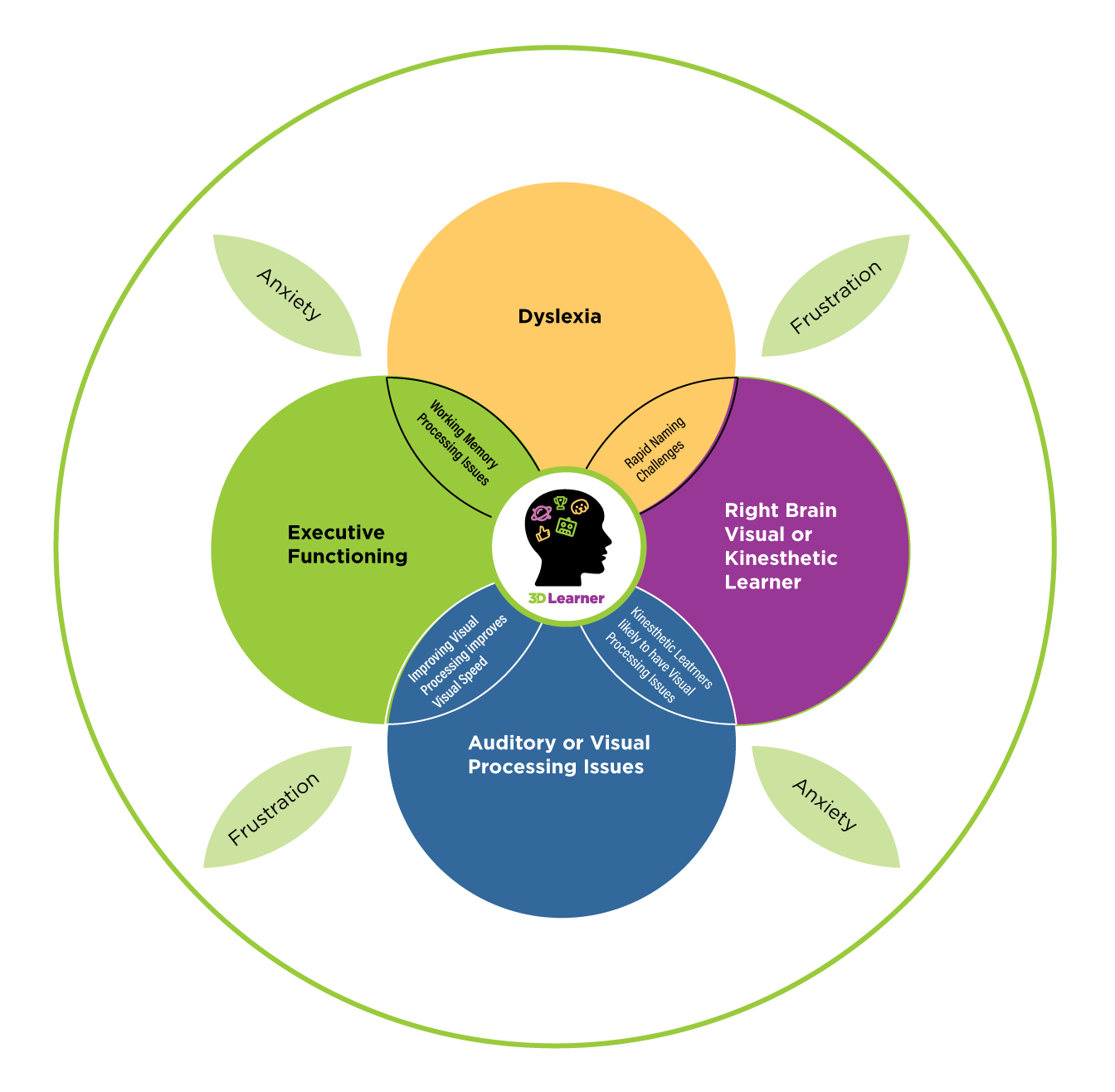
Bright Right Brain Kinesthetic Learners Benefit When One Capitalizes on Their Strengths,
while Identifying and Addressing the Relevant Issues
This Often Requires The Parents to Take Charge
Is your child a bright right brain kinesthetic learner?
- Does your child remember places visited, even from years ago?
- Does your child learn best when he or she sees and experiences information?
- Is your child a lot smarter than present results would indicate?
For a more comprehensive screening tool, download our “Is my child a right brain kinesthetic learner”.
If your child is a right brain kinesthetic learner, you play a pivotal role. Too many of these kids are identified by their challenges. These could include dyslexia, executive function issues, auditory or visual processing and/or anxiety and frustration. We have been there with two of our four kids. Over the last 26 years we have helped thousands of kids like this succeed with a process that starts by helping parents to be an informed, empowered and proactive parent.
We FRAME this differently than most. Specifically:
– Frustration comes with the territory. We encourage you to embrace the frustration and to commit to helping your child to be all they can be. If your child is a right brain kinesthetic learner, there is a good chance that when you leverage their strengths, identify and address their challenges, and leverage their desire to succeed, success is much more likely to follow.
– Reject the status quo and low expectations. Too often we have heard, parents being told that one cannot expect significant gains within a year. Two key points:
- We are seeing many kids whose reading comprehension is far below grade level. This chart shows how often students in special education fall far below grade level
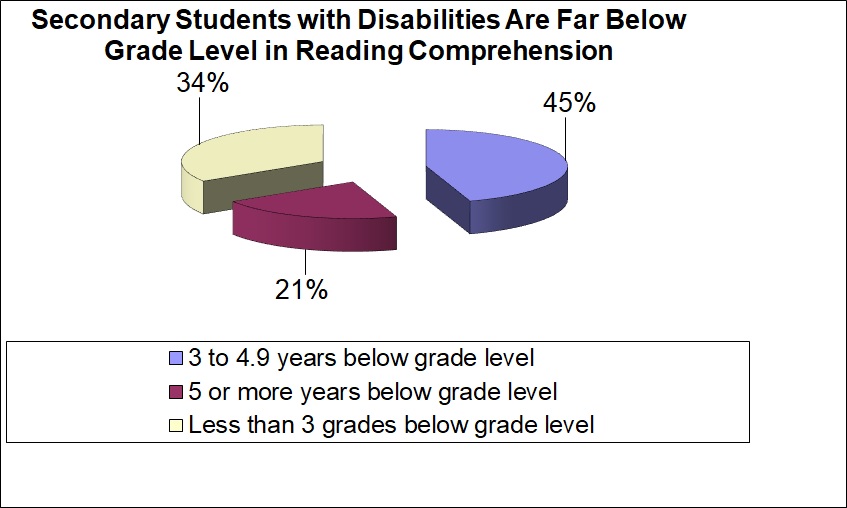
- Improving reading comprehension by 2, 3 or even 4 grade levels within 4 to 6 months is often possible. A few words of caution:
- Such results take both a commitment to training and follow-up
- Students with lower IQs and/or significant impairments may not make these gains
- Cooperation and collaboration help
Waiting is Not an Option
The next critical step is to:
Assess for Success. This would include assessing for:
- How your child learns best
- Executive function issues (e.g. working memory, processing speed and attention)
- Auditory and visual processing issues.
- Dyslexia or another learning disability
- Your child’s present level of reading fluency and reading comprehension
If the assessment shows considerable upside potential, we recommend you adopt the
Mindset that Success is the Only Option. Then you consider
- Enrolling the services of the right professional for your child and you. Ideally, you want to work with professionals who will:
- Leverage your child’s strengths
- Address their challenges
- Boost their confidence and resilience
- Help you to be the coach and advocate your child needs
- Produce excellent results within months
If you would like to discuss how to put your child on their
Pathway to Success, call us at 561-361-7495
Feel free to share with others, who have a smart struggling child with significant upside potential.
Note, next week we will have our second article on Helping Your Bright Right Brain Kinesthetic Learner succeed in 4th grade and above. That article will focus on Assessing for Success.

For the bright right brain kinesthetic learner, math word problems have become a major issue. While reading scores dropped after the pandemic, math scores dropped even further. As shown below, the percent of 4th and 8th graders meeting grade level standards on the NAEP (National Assessment of Educational Progress), dropped by 7 and 8 points respectively. The bad news is that problems with math word problems rarely self-correct.

The good news is that we have over 25 years of experience helping students to make dramatic gains in their math performance. This includes:
- A student who had been to 17 other math tutors and was operating at the1st percentile in math. We were able to get her to the 47th percentile
- A smart 4th grader, who we were able to get from the 48th to the 98th percentile

- Many students who were getting Cs, Ds and Fs, who went to As and Bs within months
If your child is experiencing difficulties with math word problems and you want to discuss what can be done,
Call us at 561-361-7495 or
Click here to schedule a Math Stress to Success Conversation
The Bright Right Brain Kinesthetic Learner may do well in the lower grades in math, but …
When math shifts in third and fourth grades to math word problems, virtually all our students have problems. This is often the result of many challenges, including:
Learning differences, visual processing issues and/or executive function issues are the multiple challenges that make math problems so difficult, and why remediation must address the relevant issues.
- The bright right brain kinesthetic learner learns differently than the logical, sequential and auditory approach that schools may use. They often have problems recognizing words, with the vocabulary and with the way the problems are worded. The right brain kinesthetic learner often does not learn how to leverage their visualization skills to understand and solve the problems.
- Visual processing issues are both common with the right brain kinesthetic learner and visual processing issues result in:
-
- Number reversals
- Not lining up the numbers correctly
- Missing signs – especially negative and division signs
- Making careless mistakes
- Executive function challenges may cause:
- Problems remembering math facts and the order of operation
- Losing focus when doing homework, during class when they are lost and during tests
- Difficulty finishing tests on time — the right brain kinesthetic learner
- Anxiety and frustration with math. We have heard too many students in the last year say, “I hate Math”.
For Bright Right Brain Kinesthetic Learners Struggling with Math Word Problems:
We Assess for Success looking
- How your child learns best
- Whether he or she has a visual processing issue
- Whether there is an attention, working memory and/or processing speed issues
We offer an Integrated, Engaging and Effective Program that often results in significant gains within months, especially for the bright right brain kinesthetic learner.
If your child is experiencing difficulties with math word problems and you want to discuss what can be done,
Call us at 561-361-7495 or
Click here to schedule a Math Stress to Success Conversation

(Call us at 561-361-7495 if you would like to discuss how your child can make significant progress this summer)
70% of our clients contact us to improve their child’s reading comprehension and executive function skills. 30% of our clients want to improve reading comprehension and executive function skills and have a Dyslexia Treatment to improve their child’s reading fluency, too.
As of July 1, we will be entering our 27th year in business. What is really troubling is that more students than anytime in our career are further behind in reading fluency, reading comprehension and math. To make matters worse, more students lack the foundational skills and confidence needed to succeed. Our goal is to help our students to make significant gains in months, to address the relevant academic skills and to identify and address the key foundation skills that are missing. We also strive to reduce anxiety, boost confidence and instill a love for learning.
If you want to have a conversation on Creating a Pathway from Stress to Outrageous Success for your child,
– Call us at 561-361-7495 or
– Find a mutually agreeable time on our schedule by clicking on Let’s Schedule a Conversation.
On Thursday May 4th, we will be hosting a webinar at 8:30 pm on a
Summer Program to Dramatically Improve Reading Fluency, Reading
Comprehension, Executive Function Skills and Confidence.
Click here to register for our Parents make The Difference Webinar
What makes 3D Learner a unique offering:
- We tailor our program to meet the key goals we set with parents. These might include: improving reading comprehension by 2, 3 or even 4 grade levels in 4 to 6 months; improving reading fluency; improving attention, working memory and/or processing speed; addressing visual processing in a way that improves academics and athletic skills: and/or reducing anxiety, building confidence and igniting a love for learning
- Our assessment process evaluates reading fluency, reading comprehension, executive function skills, visual processing, how your child learns best, where your child is strong and where they struggle. We then incorporate a debrief that results in setting goals for the next 4 to 6 months. If you would like, we then provide program options that can address some or all of the relevant issues.
Our process allows us to identify the bright right brain kinesthetic learner, who is often much smarter than present results would indicate. We also provide an in-depth look at how your child’s eyes track when reading; whether your child has an attention, working memory and/or processing speed issue; and to what extent there are issues with decoding, phonemic aware, and reading fluency
Our process starts with an assessment that identifies: the right brain kinesthetic learner; whether there are a visual processing, working memory, processing speed and/or attention issue; whether dyslexia is present; and your child’s present level of reading comprehension.
We also provide parent training that helps you to become even more effective coaches and advocates for your child.
- We use the UFLI Program ® to improve decoding, phonemic awareness and reading fluency, where needed. This program moves at a faster pace than most, but reinforces what the student has learned throughout the process. This is a dyslexia treatment that fits well into our program.
- We target the areas of greatest need. Often this includes some combination of reading comprehension, reading fluency, executive function, visual processing and reducing anxiety, while building confidence. Note, the length of our program depends on your child’s needs and your goals.
It is important to note, that while a number of our students have made considerable gains, these are not possible for all students. We see the most significant gains in the student with above average and even gifted IQs who are performing well below their potential. We strive to be BOLD but realistic when we set goals.
Note, our program was designed for our daughter who was able to improve her reading comprehension 4.2 grade levels in 7 months. Today, our clients are mostly between the ages of 6 and 17.
What delights us is that we can help students to make significant gains. The first place we really make the difference is with our initial conversation. Three examples:
- Mom called with a problem that is impacting many students today. The private school her son attended suggested she find a different school for her son, based on his reading comprehension being 2 years below grade level. She called us and after 10 minutes she commented, “How is it you know my son better than anyone at his school who have known him for 4 years”. She came to us from out of state and her son improved his comprehension 3 grade levels in a year. His teacher said, “Thomas made more progress in a year than any student I have had in 27 years of teaching
- Mom called from the state of Washington. She had been told her son was a right brain visual learner, who learned best when he saw and experienced information. She too was surprised how well we knew her child. Her son was able to improve his reading comprehension 4 grade levels in 7 months and blossom as a student.
- A local mom called us. She heard about us from a friend, where we had helped her friend’s gifted son go from the 58th to the 99th percentile in reading comprehension. Note, he later went to MIT. Mom had a son who was smart, but his reading comprehension was 4 years below grade level. Her challenge was that her son did not realize how smart he was. Our assessment showed that as he was about to enter 9th grade, he was at college level on 9 out of the 26 skills we assessed and only had 4 areas where he was weak. For the first time he saw himself as a smart kid who learned differently. In less than 4 months, he was able to improve his reading comprehension from the 5th to the 9th grade level and increase his reading speed from 200 to 360 words per minute. He went onto get several full college scholarships
All this starts when the parents engaged in a conversation to discover how her child could succeed.
Click here to register for our Parents make The Difference Webinar
If you want to have a conversation on Creating a Pathway from Stress to Outrageous Success for your child,
– Call us at 561-361-7495 or
– Find a mutually agreeable time on our schedule by clicking on Let’s Schedule a Conversation
Our Assessment Special
Complete a Comprehensive Assessment in May and receive the Safe and Sound Protocol ® — ordinarily a $300 investment — that will help your child and you reduce stress and anxiety
.

For immediate help call us at 561-361-7495 or join us May 2nd for our Beat Grade Retention Webinar
There is a Silver Lining to Avoid Third Grade Retention and Other Grade Retention Risks
“Your child is at risk of third grade retention”, was the note from her daughter’s school. Mom was not happy. She called a friend who suggested she contact 3D Learner. She immediately called us and we asked the following questions:
- Does your child learn best when he sees and experiences information?
- Does your child skip words and lines when reading?
- Does your child lose focus when reading or taking tests?
- Does your child read slowly?
- Is your child a lot smarter than her present reading comprehension level would indicate?
Her answers were yes to all the questions, and she commented that it was like we knew her daughter.
The friend had told her that we had helped her child increase her reading comprehension to above grade level and her daughter was reading above grade level on her 4th grade test. She wanted to know if that was possible for her child. We explained that that is our goal.
The good news is that her daughter beat third grade retention, scored above grade level in 4th and 5th grades after working hard and completing the 3D Learner Program ®. She continues to do well in middle school.
We have helped many students beat both third grade retention and grade retention in the earlier grades.
We have a three-pronged strategy:
- Provide the student and the parent with strategies to produce better test results with exercises to reduce stress, recommendations on sleep and diet, how to make sure your child gets the accommodations that are prescribed in an IEP or 504 Plan, and how to talk to your child to reduce their stress and boost their confidence. Click here for a video we created with “Strategies to reduce your child’s stress and anxiety”.
- We understand all the Good Cause Exemptions that can be used to avoid third grade retention.
- Significantly improve reading comprehension and test scores by:
-
- Capitalizing on how our students learn best. Most of our students are bright right brain kinesthetic learners, who do far better with our engaging and effective hands-on learning
- Identifying and addressing visual processing issues, where needed. Over 70 percent of the students we test either skip words and lines when reading and/or read slowly
- Identifying the executive function skills that are impacting a student’s performance. This might include attention, working memory and/or processing speed
- Addressing the relevant decoding, phonemic awareness and reading fluency challenges, whether or not a child has dyslexia
- Teaching the student visualization skills to relate and understand what they are reading
- We strive to ignite a love for learning
- Systematically improving reading comprehension levels — often by 2 grade levels over 3 to 6 months
This visual explains the 3D Learner Process
Most students at risk for third grade retention or any other grade retention are often a right brain kinesthetic learner and often struggle with visual processing, executive function deficits, dyslexia and/or anxiety. The best way to help these students is to significantly improve their reading comprehension and test scores by capitalizing on their strengths, addressing their challenges and building their self-esteem and confidence.
If your child is facing third grade retention or any grade retention and you would like help,
Call us at 561-361-7495 for a no cost conversation, or
Click here to find a mutually agreeable time on our schedule for a
Avoid Grade Retention Conversation
We encourage you to join us on May 2nd at 8:30 pm for a
Beat Third Grade Retention and Other Grade Retention Risks.
We will provide an explanation of why many students are retained and how parents can help their child to beat grade retention.
Background Information on Third Grade Retention & Other Grade Retention
Mandatory third grade retention is a key strategy some states use. Sometimes this results in schools using grade retention in earlier grades. The theory is that students need to be on grade level by the end of third grade in order to succeed. In states like Florida, third grade retention laws have been in place for over 20 years. The short-term benefits from grade retention tend to dissipate over time. As a parent, if your child is facing grade retention, the pressure is real — on both your child and you.
Note, most students at risk for grade retention are right brain kinesthetic learners, who can significantly improve their reading comprehension skills with a strength-based approach.
5 points for parents to consider:
- There are many ways to avoid third grade retention and grade retention in earlier grades. In Florida, there are a number of good cause exemptions to third grade retention. Here is a link to a Florida Department of Education document that describes the options.
- Note, there are some parents who are focused on having students opt out of the end of year testing. One word of caution: the easiest path to promotion is to get a Level 2 on the last test given in May. It requires your child to be at about the 20th percentile. If you opt out, all the other options are harder to achieve.
- Encourage parents to get more help, so their child no longer struggles.
Note, virtually all students at risk for grade retention are well below grade level in reading comprehension.
- To provide an option where the goal is to help your child to become Outrageously Successful in months by improving reading comprehension, executive functions skills and reducing anxiety.
- To encourage those who would like more information to
Join us on Tuesday night May 2nd for a Webinar on
Parents Guide to Avoid Grade Retention and
Help Your Child Be Outrageously Successful
If you need immediate help,
a) Please contact us directly by calling 561-361-7495
b) Clicking here to schedule a Zoom meeting at a mutually agreeable time for a
Beat Grade Retention Conversation
Recent Comments