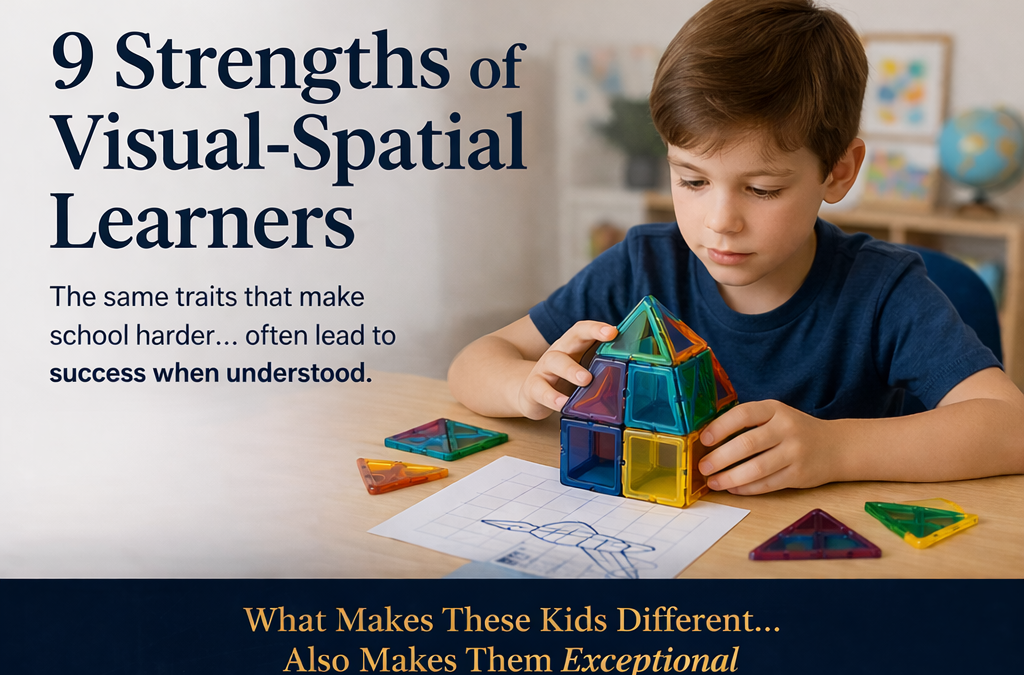
Many smart struggling children are visual-spatial learners—with powerful strengths that are often overlooked.
If your child is bright but struggling in school… it’s easy to focus on dyslexia, attention (ADHD), or executive function challenges.
But here’s the shift most parents never hear:
When you recognize your child’s strengths, you can stop managing problems
and unlocking potential.
If you are not sure if your child is a visual-spatial learner, download our no cost screening tool “is my child a visual-spatial learner”. Print out two copies. Complete one yourself and have your child answer the questions, too. Their answers may surprise you.
3D Learner recognizes each child is different. If you want to discuss your child’s situation, give us a call at either 919-371-5295 or click here to schedule a Stress to Success Conversation.
1. Thrive When Understood
The visual-spatial learner has a sea of strengths and challenges. To make matters worse they often:
- Have to work much harder than their peers or siblings
- Struggle to understand what they hear and read
- Are frustrated and anxious
- Are a lot smarter than present results would indicate
The visual-spatial learner needs their parents to reject the status quo, see their potential and take control of their education
2. Learn Best Through Seeing and Doing
They learn most effectively when they:
- See it
- Experience it
- Interact with it
This is why traditional teaching often frustrates them—and why the right approach can accelerate progress. Understanding their strengths helps parents, teachers and professionals
3. Visual-spatial learners can reach their potential when they work with professionals who:
- Teach the way they learn best
- Identify and address their challenges
- Help their parents to be the coach and advocate they need

Visual-spatial learners can succeed when they are taught to their strengths, their challenges are identified and addressed, and their parents are the coach and advocate they need
4. Natural Goal Setters (When Engaged)
- Respond best when involved in the goal setting
- Benefit from understanding the WHY
- Helps to set a goal for their preferred non-academic activity (e.g. Baseball, dance, music etc.)
5. Driven to Succeed
This may be the most important strength of all.
When a visual-spatial learner is:
- They may stay driven without external pressure
- Do best when there is a visual that shows their progress
- Helps when they can innovate on how to achieve the goal
- Supported as a whole child by parents, teachers and other professionals
They often:
- Gain confidence quickly
- Accelerate academically
- Begin to enjoy learning again
What once looked like struggle can turn into rapid growth.
The key is alignment—not force.
6. Big-Picture Thinking
Visual-spatial learners naturally see how ideas connect.
They often:
- Understand concepts before steps
- Grasp meaning quickly
- Struggle with fragmented, step-by-step instruction
7. Creative Problem Solving
They don’t just follow directions—they figure things out.
They:
- Approach challenges from new angles
- Find solutions others miss
- Think beyond “the expected way”
8. Powerful Imagination
They think in:
- Images
- Stories
- Possibilities
What looks like distraction is often deep internal thinking.
9. Strong Pattern Recognition
They learn most excellent at:
- Spotting patterns
- Seeing relationships
- Understanding systems
This is a key foundation for advanced thinking.
The Shift That Changes Everything
When you stop asking:
“What’s wrong with my child?”
…and start asking:
“How does my child learn best—and how do we build around that?”
3D Learner recognizes each child is different. If you want to discuss your child’s situation, give us a call at either 919-371-5295 or click here to schedule a Stress to Success Conversation.
3D Learner, where we help parents make the difference and leverage visual-spatial learner strengths
If you would like to discuss how to leverage your child’s strengths, give us a call at 919-371-5295 or 561-361-7495 or click here to schedule a Stress to Success Conversation.

Is your child a visual-spatial learner?
- Does your child have an excellent memory for what he or she sees and experiences?
- Does your child learn best when he or she sees and experiences information?
- Is your child a lot smarter than present results would indicate?
- Is your child a lot smarter than present results would indicate?
If you are not sure if your child is a visual-spatial learner, download our “Is your child a visual-spatial learner” screening tool. Make two copies. Complete one yourself and one with your child – their answers may surprise you.
If your child is a visual-spatial learner,
Your child may struggle with reading fluency, writing output, working memory, or processing speed — yet show remarkable strengths in reasoning, creativity, problem-solving, and big-picture thinking.
One critical point, if this describes your situation, your child can probably make significant gains over the next several months with the right program.
So when parents ask us:
- How is the 3D Learner Program different from other programs?
- Is a spring or summer program better?
- How do I know what’s best for my child?
Here’s what we tell them.
The 3D Learner Difference
The 3D Learner Program® was developed by educator Mira Halpert in 1996 and is grounded in the research of psychologist Dr. Linda Silverman, founder of the Gifted Development Center.
Dr. Silverman identified the unique learning profile of visual-spatial learners — students who:
- Learn best when they see and experience information
- Often have strong visual reasoning but weaker auditory working memory
- May struggle in traditional, sequential classrooms
- Often test far higher on fluid reasoning and verbal comprehension than they do on working memory and processing speed.
In a large-scale study of 390 gifted children nationwide (Gilman, et al., in press), the Verbal Comprehension Index (134) was 2 standard deviations higher than the Processing Speed Index (104). Processing Speed measures eye-hand coordination and speed.
- Often have some combination of learning differently, dyslexia, executive function challenges, auditory and visual processing issues and/or anxiety.
Your Visual-Spatial Learner may benefit from a strength-based program that also identifies and addresses their challenges, builds their self-esteem and helps you to be an even more effective coach and advocate for your child.
The 3D Learner approach is different because it:
- Teaches to your child’s strengths first
- Combines structured literacy with visual-experiential methods
- Builds executive function and processing skills — not just accommodations
- Targets reading fluency, comprehension, vocabulary, math, and writing
- Restores confidence while improving performance
- Can be tailored to meet your child’s unique needs
This is not just tutoring.
It is transformational skill-building tailored specifically for how your visual-spatial learner thinks and their challenges.
If you are considering a spring or summer program for your visual-spatial learner to make significant gains before the next school year, click here to schedule a no cost Stress to Success Conversation or call us at 919-371-5295 or 561-361-7495.
Spring or Summer — Which Is Better?
The honest answer?
It depends on your child and your schedule.
A Spring Program May Be Best If:
- Your child is struggling right now and needs immediate support
- You want to see the best possible results before the next school year
- Confidence is dropping during the school year
- Testing or school decisions are approaching
- Your summer schedule will not allow the time to do a program
- It may favorably impact their ability to get in or stay in the school you want them in.
A Summer Program May Be Best If:
- You want uninterrupted, intensive progress
- School-year stress is too high
- You prefer concentrated skill-building without homework pressure
- You want your child starting next school year stronger and more confident
Both options can produce meaningful gains.
The key is choosing what works best for your child and your family rhythm.
What Truly Changes Outcomes?
The biggest difference isn’t spring vs. summer.
It’s whether the program:
- Leverages how your child learns best
- Improves reading fluency and/or reading comprehension, where needed
- Addresses processing and executive function gaps
- Builds academic skills AND self-esteem
- Gives your child a new experience of success
- Can be tailored to your child’s unique needs
- Has significant experience with helping kids like yours make significant gains within months
When visual-spatial learners are finally taught in a way that makes sense to them, the shift can be dramatic — academically and emotionally.’’
In addition to one-on-one programs, we offer a group program. At present, we are trying to put together a group for 4th to 6th graders.
If you are interested in spring or summer programs for your visual learner, click here to schedule a no cost Stress to Success Conversation or call us at 919-371-5295 or 561-361-7495
Four examples of what is possible
A first grader whose parents were told in April that grade retention was a virtual certainty. With our help, by mid-May, 5 weeks after starting the program, he had made so much progress that grade retention was no longer being considered.
A third grader, whose parents had been told to find another private school because of his reading comprehension issues, improved his reading comprehension by 3 grade levels and according to his teacher, “T made more significant gains than any student I had had in 27 years of teaching”, Ms D MD
A 5th grader, whose parents had spent $34000 on a well-known dyslexia program, made the following gains over the next 6 months:
- Improving her reading comprehension from the 1st to the 5th grade level
- Increasing her reading speed from 115 to 229 words per minute
- Decreasing homework time from 2.5 hours to 1 hour and 15 minutes
- Decreasing the time mom had to spend doing homework from 12 hours a week to 2 hours a week — a saving of 10 hours a week or 350 hours over a school year
A rising 9th grader who was able to:
- Improve his reading comprehension 4 grade levels in 3 months
- Increase his reading speed from 200 to 360 words per minute
- Improve his grades from a C to an A average
If you are considering a spring or summer program for your visual-spatial learner to make significant gains before the next school year, click here to schedule a no cost Stress to Success Conversation or call us at 919-371-5295 or 561-361-7495.
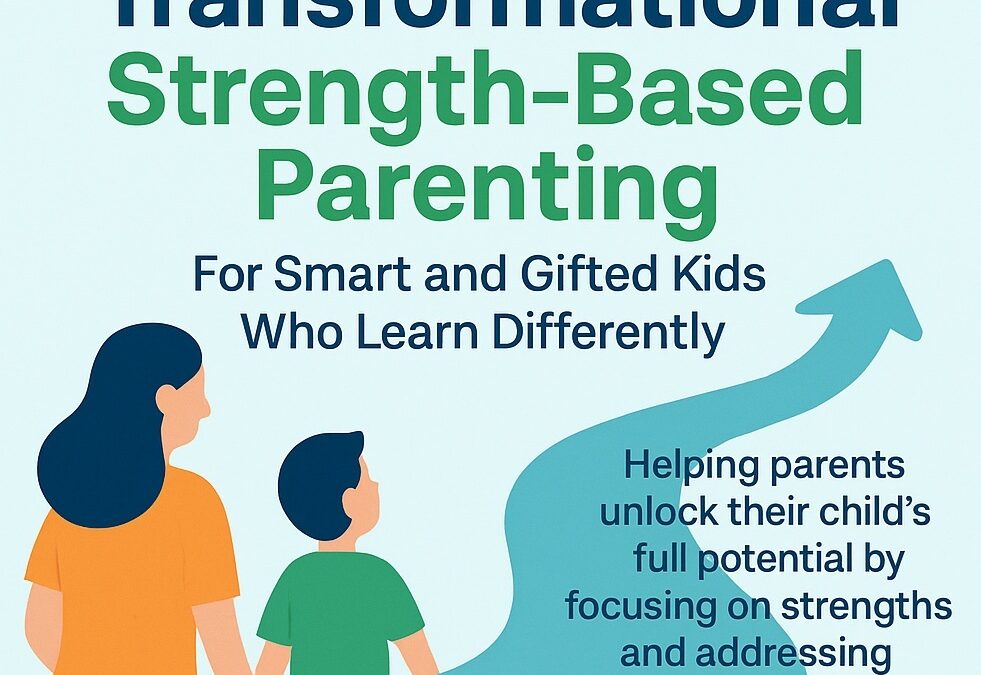
Many smart struggling students learn differently and have executive function issues.
That is, they learn best when they see and experience information – are what we call a visual-spatial learner and have problems with attention, working memory and/or processing speed issues (i.e. executive function skills). If you suspect your child may be a visual-spatial learner, a child who learns best when he or she sees and experiences information, we suggest you download this no cost screening tool, “Is your child a visual-spatial learner?” We recommend you complete one copy of the assessment and have your child answer the other questions. Their answers may surprise you.
If your child is a smart or gifted visual-spatial learner and has executive function issues, the combination of the 3D Learner Program and the BrainWare Safari Program can help your child make significant gains in their reading fluency, reading comprehension, executive function skills and more within months. Click here for more information on the 3D Learner Program, BrainWare Safari Program and the combination of the two.
As parents and educators, we have been there with two of our four children and thousands of our students who struggle with:
- Learning differently. Most schools and programs teach in a logical, sequential and auditory way. Smart and even gifted visual-spatial learners can struggle for years, because they learn differently. One study found that 62 percent of the kids are visual-spatial learners. We estimate that over 80 percent of the smart and gifted kids who struggle are visual-spatial learners.
The 3D Learner Program ® was specifically developed for our daughter who was a visual-spatial learner. It helped her to improve her reading comprehension 4.2 grade levels in 7 months. The 3D Learner Program is designed to help the visual-spatial learner to make significant gains in months.
- Reading fluency and/or reading comprehension issues. As one mom said, “I was told my child had dyslexia, which is a problem with reading fluency, I did not realize how significant my child’s reading comprehension issue was and that the dyslexia training did not address reading comprehension
- Remembering what they hear or read — what one would call a working memory issue

Working memory problems tend to persist
- Reading slowly and often avoiding reading silently. We have seen smart and gifted students whose reading speed was 100 words per minute and even 72 words per minute. This makes reading books take a long time and dramatically impacts performance on standardized tests. This is often due to a processing speed issue, that often impacts reading speed and the ability to quickly process auditory information
- Paying attention to that which is boring or frustrating. As Thom Brown, a leading psychiatrist at Yale said, “Inattention is the inability to pay attention to that which is boring or frustrating”.
It is often the child who can hyperfocus on things that interest them who has difficulty paying attention to that which is boring or frustrating.
- Processing speed. The visual-spatial learner often processes in pictures, and this takes far longer than processing in words
- Visual processing challenges – where your child may skip words and lines when reading, see words moving on the page, have difficulty lining up math work correctly and have difficulty catching or hitting a ball
- Anxiety and frustration as academic struggles worsen, despite knowing they are smart
- Having difficult with logical, sequential and auditory teaching, while being far better and maybe gifted when they are allowed to learn by seeing experiencing the information
As parents you may be frustrated with your smart or even gifted child’s struggles, despite a massive investment of time, money and effort. The right intervention can teach to your child’s strengths, address their problems with reading, writing, math and executive function skills and generate significant results in months
Our goals are to:
- Alert you to the risks that if your child learns differently and/or has executive function issues, they may never reach their full potential without an integrated intervention that capitalizes on their strengths and addresses their challenges.
- Help as many parents as possible to become a Transformational Strength-based Parent, who identifies and leverages their child’s strength, identifies and addresses their child’s challenges and who finds the right program for their child that will help their child succeed, possibly within months.
For the child who learns differently and/or has executive function challenges, it is up to parents to make the difference
- To highlight the key conditions that often impact the child who learns differently. The infographic below shows the five characteristics we often see in a smart or gifted visual-spatial learner — they learn differently and often have 2, 3 or 4 of the following:
-
- Executive function issues
- Visual processing issues
- Dyslexia or a learning disability
- Anxiety challenges
The visual-spatial learner with executive function and related issues, must rely on their parents to make the difference – schools often do not identify or address learning differences or executive function issues
- Highlight the value of an integrated, engaging and effective program that leverages your child’s strengths, identifies and addresses your child’s challenges, boosts their confidence and helps you to be the coach and advocate your child needs
- Offer you the opportunity to have a no cost conversation on how you can make the difference.
If you are interested, we are offering a no cost 30 minutes conversation
focused on how you can make the difference for your child.
To schedule a time, you can either
What the 3D Learner Program ® and the BrainWare ® Safari Program offer:
- A comprehensive assessment to see how your child learns best, what challenges are holding them back, what their present level of reading comprehension is and what program or programs can make the difference. We offer the Mindprint Assessment of Cognitive Abilities ®, that was developed at the University of Pennsylvania, to identify a student’s executive function strengths and challenges, and to tailor a program to meet the student’s needs
- For the child with significant Executive function challenges, the BrainWare Safari Program improves attention, processing speed, and working memory. This well researched program contains 20 exercises comprising 160 progressively challenging levels that develop and strengthen 43 cognitive (mental processing) skills
- The 3D Learner Program improves spelling, reading fluency, reading comprehension, math skills, visual processing, and self-confidence, while reducing anxiety and homework challenges. Using the UFLI Dyslexia program, we are fully certified Dyslexia specialists. We also work with parents to help you become an even more effective coach and advocate for your child
- The combination of these two programs can significantly improve your child’s skills.
What Parents Notice
- Better reading fluency and significantly increased reading speed
- Better reading comprehension
- Much higher standardized testing scores
- Stronger math reasoning and much higher math grades
- Less homework time and stress
- Increased confidence
- Significant improvement in attention, working memory and processing speed
- A child who is far better in their preferred activity — be it sports, martial arts, dancing, music or …
- A child who believes in themselves again
Our goal is Outrageous Success in Months
Is This Right for Your Child?
This combined approach may be ideal if your child:
- Is bright but underperforming
- Struggles with programs that focus on their challenges and does not teach to their strengths
- Struggles with reading fluency and/or reading comprehension
- Has problems with attention, working memory, processing speed and/or visual processing
- Works hard but is not closing the gap
- Feels frustrated or anxious about school
- You want help to be an even more effective coach and advocate for your child
Note, we offer the 3D Learner Program and the BrainWare Safari Programs separately, and our best offering is a combination of the two, when needed.
Parents Can Make the Difference
You are uniquely positioned to change your child’s trajectory.
Start with clarity.
Schedule a Pathway to Success Conversation
We can discuss:
- Your child’s key challenges
- What you have previously tried — and how it helped and what was missing
- Their unique strengths
- What your biggest challenges and fears are
- What would you would like to accomplish
- Small changes that can make big difference
- Whether 3D Learner ® and/or BrainWare Safari ® are the right fit
And outline a personalized roadmap forward.
If you are interested, we are offering a no cost 30 minutes conversation
focused on how you can make the difference for your child.
To schedule a time, you can either
Two Powerful Opportunities for Visual-Spatial Learners
Applications open February 1, 2026 – click here to access the applications for the Florida Empowerment Scholarship for Unique Abilities (FES-UA) and here for the Personalized Education Program.

If you’re a Florida parent exploring school choice options for 2026, two state-funded voucher programs deserve your close attention—especially if your child learns differently.
Note, 3D Learner is an approved provider for both programs.
Two Florida Programs Parents Should Know About
Florida Empowerment Scholarship for Unique Abilities (FES – UA)
- $10,000+ per year
- For private or homeschool students with a qualifying disability
- Funds may be used for private tutoring, educational therapy, curriculum, and services
Personalized Education Program (PEP)
- $8,000 per year
- For private or homeschool students without a qualifying disability
- Flexible use for customized education and tutoring
Both programs can be used for private tutoring—like ours
Many private and homeschool parents tell us the same thing:
“My child is smart, but school just doesn’t seem to work for them.”
Often, the missing piece is teaching how your child learns best.
One Critical Question Parents Often Miss
Does your child learn differently?
We’ve worked with thousands of private and homeschool families, and we consistently see one pattern:
Many struggling private-school and homeschool students are visual-spatial learners.
A visual-spatial learner:
- Learns best when they see, experience, and interact
- Thinks in pictures, patterns, and big ideas
- Is often very bright, yet underperforming academically
- Can often excel with a program that teaches to their strengths and identifies and addresses their challenges that may include dyslexia, executive function issues, visual processing issues and/or anxiety. Most students we see learn differently and have a few challenges.
3D Learner focus is on leveraging the strengths of the visual-spatial learner, while identifying and addressing their challenges
The Hard Truth
Traditional programs—especially those that are:
- Logical
- Sequential
- Auditory
- Worksheet-heavy
…often do not help your child to be as successful as they could and should be
The result?
Even in good private schools, these students can fall further and further behind, particularly in reading comprehension, writing, and executive function—while anxiety and self-doubt grow.
Results our Clients Have Achieved
Student #1 – Homeschool, Florida
After two years in two different dyslexia programs, a second-grade student’s reading comprehension was still reading at a kindergarten comprehension level.
After our initial call, the mom said,
“I was stunned by how quickly you understood where my daughter excelled, where she struggled, and the anxiety it created—for both of us.”
Results:
- 2 grade level improvement in reading comprehension in 4 months and 3 grade levels in 7 months
- Read 23-chapter books in 7 months, after previously never having read one on her own.
- Improved focus and confidence carried over into dance performance
— Jennifer B., Florida
Student #2 – Private School, Florida
A third grader was told he should find another school because his reading comprehension was two years below grade level.
After less than 10 minutes on the phone, his mom said:
“How is it that you seem to know my son better than people who have known him for years?”
Results:
- 3 grade levels in improvement reading comprehension in one year
- Stayed at his private school
- Teacher commented:
“He made more progress in one year than any student I’ve had in 27 years.”
If You Suspect Your Child Learns Differently
Step 1: Download Our Free Screening Tool
We recommend:
- Print two copies
- Complete one yourself
- Ask your child to complete the other – their answers may surprise you.
Parents are often shocked by how clearly their child describes their own learning style.
Step 2: Use These Programs Strategically
For children who learn differently, Florida’s voucher programs can open the door to support that actually works.
The right approach can help you:
- Teach the way your child learns best
- Identify and address dyslexia, ADHD, executive function, and visual processing issues
- Become a more effective parent-coach and advocate
4. Achieve significant gains in months—not years
5. Give your child more confidence, success, and future options
Final Thought for Florida Parents
The Florida Empowerment Scholarship for Unique Abilities and Personalized Education Program are not just funding options.
Used well, they are opportunity multipliers—especially for:
- Visual-spatial learners
- Smart kids who learn differently
- Families ready for a strength-based, transformational approach
Ready to Take the Next Step?
We’d love to help you decide how to use these programs to help your child thrive—not just get by.
Because when you teach the way your child learns best, everything changes.
Your dyslexic child may be a visual-spatial learner with dyslexia.
For the dyslexic child, the focus is understandably placed on decoding, phonemic awareness, and reading fluency. For some students, this approach leads to meaningful gains in fluency and comprehension.
However, for many smart and even gifted dyslexic children, progress is limited—not because the dyslexia program was wrong, but because it was not enough.
In our experience, many dyslexic students learn differently. They are often what we call visual-spatial learners—children who:
- Learn best when they see and experience information
- Think in pictures and often in 3 dimensions
- Often struggle when instruction is overly verbal, linear, or worksheet-based
At 3D Learner, we regularly work with students who come to us after 1, 2, 3—even 7 years of dyslexia programs and are still struggling with one or more of the following:
- Reading comprehension
- Attention and focus
- Working memory
- Processing speed
- Visual processing
- Anxiety or school-related stress
For these students, a dyslexia program is often necessary—but not sufficient.
Our Strength-Based Difference
At 3D Learner, we put the strengths of the visual-spatial learner at the center of our work. From there, we identify and address dyslexia and other contributing challenges, such as:
- Executive-function weaknesses
- Visual-processing issues
- Attention challenges
- Anxiety

This integrated, strength-based approach allows us to help students not only improve academically, but also rebuild confidence, motivation, and a “can-do” mindset.
Why This Matters for Parents
If your child is a visual-spatial learner, it can significantly impact:
- How you coach and advocate for your child
- Which teacher or learning environment is the best fit
Which programs are most likely to capitalize on your child’s strengths and interests, while still addressing their challenges
Not Sure If Your Child Is a Visual-Spatial Learner?
We recommend downloading our Visual-Spatial Learner Screening Tool.
Many parents find it helpful to:
- Answer the questions themselves
- Then ask their child the same questions
The insights can be eye-opening.
Ready to Take the Next Step?
If your child appears to be a visual-spatial learner with dyslexia and you’d like to explore how you can help them succeed, we invite you to connect with us.
Recent Comments