
Especially for Smart and Gifted Middle and High School Students Who Learn Differently
Is your child bright, creative, curious, or a gifted middle school and high school child who is struggling with reading, reading comprehension, focus, homework, confidence, or executive function skills?
Over the last 29 years, 3D Learner has helped thousands of students significantly improve reading fluency, reading comprehension, executive function skills, confidence, and so much more.
What makes 3D Learner different is our focus on smart and gifted kids who learn differently — especially children who learn best when they see, experience, build, move, and connect ideas in meaningful ways. We use the term visual-spatial learner to describe our students — because they often have great visual memories, and they think in 3 dimensions.
Note, until recently, 3D Learner was based in Boca Raton, FL. We are now located in Durham, NC. We serve both local clients (e.g those in Raleigh, Durham and Chapel Hill and beyond) and clients nationwide and worldwide through our live training, our hybrid training (where parents have brought their child to us, from 40 states and 13 other countries) and our online programs.
We offer several programs including:
– The 3D Learner Program ® – a 30-hour program that is hands-on, integrated, engaging and effective at improving reading fluency, reading comprehension, attention, test scores and self-esteem – where we help the students succeed and the parents to become even more effective coaches and advocates for your child.
– The Brainware Safari Program ® to improve executive function skills.
– A combination of the 3D Learner Program and the Brainware Safari Program.
Our Summer Intensive is designed for students who can do far better with an integrated, engaging, and effective approach. We tailor efforts to meet your child’s needs.
Schedule Your No-Cost Conversation Today
If what we share describes your child and what you hope to accomplish this summer or later, you can either call us at 919-371-5295 or 561-361-7495 or click here to schedule a no cost conversation on helping your child to make significant gains in reading comprehension and/or executive function skills in months.
Why Summer Can Be the Turning Point for Your Middle or High School Child
For smart and gifted kids who learn differently, three things are especially important for parents to understand:
1. The risks are real
Academic and emotional challenges often do not disappear on their own. Reading struggles, weak comprehension, poor working memory, slow homework, anxiety, low confidence, and executive function issues may persist — and often worsen as school becomes more demanding. Note, a review of NAEP scores (the national assessment of educational progress) shows that 8th graders in the 50th percentile, the 25th percentile and the 10th percentile have lost significant ground from 2013 – 2024 in both reading and math.

This decrease amounted to students in the 25th to 50th percentile losing a half to a year or more versus their peers and for those in the 10th percentile losing a year. This means students who were 1 to 2 years below their peers previously are now 1.5 to 3 years below their peers. The results are worse for math.
As shown by a Mindprint Study of close to 40,000 students, post COVID, executive function skills have declined significantly, especially for working memory and flexible thinking skills.
Note, we use the Mindprint Assessment ®, developed at the University of Pennsylvania, to assess Executive Function strengths and challenges.
2. The upside can be enormous
When the right strengths are identified and the right challenges are addressed, many smart struggling students can make significant gains in months — gains that can transform school, confidence, and family life.
At 3D Learner our goals are often to help middle and high school students to make 2 or even 3-year gains in their reading comprehension over 4 months and to improve math and executive function skills, while boosting self-esteem and igniting a love for learning. Note, rather than looking at just deficits like dyslexia, ADHD, executive function deficits, 3D Learner has a three-dimensional approach that
- Identifies and capitalizes on your child’s strengths
- Identifies and addresses their challenges
- Helps students to make significant gains in months, with parents as our partners

3. Parents can make the difference
You are the best-positioned person to take charge of your child’s future. With the right mindset, the right partner, assessment, the right goals, and the right action plan can change everything.
Schedule Your No-Cost Conversation Today
If what we share describes your child and what you hope to accomplish this summer or later, you can either call us at 919-371-5295 or 561-361-7495 or click here to schedule a no cost conversation on helping your child to make significant gains in reading comprehension and/or executive function skills in months.
Three Stories of Parents Who Chose to Make the Difference
Story 1: From 2nd to 6th Grade in Reading Comprehension with Significant Improvement in Baseball Skills
The parents were at wits end. Their child was in remedial reading, there were lots of behavior problems and their son was struggling with reading, behavior and baseball
A person at her son’s school recommended 3D Learner.
That mom called 3D Learner.
In the first conversation, she felt we understood her child.
The challenge was getting her son to buy-in. When we discussed what his baseball struggles were like and that we could improve his baseball performance, he changed from being reluctant to being excited.
With the 3D Learner approach, her son improved his reading comprehension 4 grade levels in 4 months, improved from a C to an A student and improved his batting average from 260 to 386. His home run production improved from 1 to 10. Even better, he now qualifies for regular classes, where there were far fewer behavior challenges and distraction.
Improved attention, neural timing and confidence helped academics, baseball and his life
For middle and high school students, we are often able to engage them in what we do because it will improve their performance in a non-academic activity — sports, dance, martial arts, etc.
Story 2: Can You Help My Rising 9th Grader Succeed
A second mom was intrigued by our webpage and called us. Her son’s reading comprehension was at the 5th grade level, his reading speed was only at 200 words per minute and he was what we called “yet to be motivated.
With our help, her son improved his reading comprehension 4 grade levels in less than 4 months, improved his reading speed from 200 to 360 words per minute and his motivation improved dramatically. He also improved from a C to an A student and was able to qualify for college scholarships.
Story 3: Improving Reading Comprehension by 4 Grade Levels for a Smart Struggling 8th grader Who Needed Us to Work Online
A homeschool mom was concerned about her daughter’s reading comprehension and math. Her rising 8th grader was reading at the 4th grade level and so was her math. For multiple reasons, the student was not able to come to our office and all the work had to be done remotely. After less than 5 months, her daughter was on grade level in both reading and math — it can be done remotely.
Who This Summer Intensive Is For
This program may be a strong fit if your child is:
- Smart, very smart, gifted, or twice-exceptional
- Struggling with reading fluency or reading comprehension
- Weak in executive function skills such as attention, working memory, planning, processing speed, or flexible thinking
- Diagnosed with dyslexia, ADHD, anxiety, or learning differences
- A visual-spatial learner or experiential learner
- Performing far below what you know they are capable of
- Losing confidence, avoiding schoolwork, or becoming emotionally overwhelmed
What Makes 3D Learner Different
Most programs focus primarily on the weakness.
3D Learner starts with the child’s strengths.
We identify how your child learns best, what is getting in the way, and what kind of integrated plan can help them move forward faster.
Our approach may include reading comprehension, fluency, executive function training, visual processing support, experiential learning, confidence-building, and parent coaching — all designed around your child’s unique profile.
The Goal
The goal is not just to help your child read better.
The goal is to help your child become a more confident, capable, independent learner — and to help you become the coach and advocate your child needs.
Take the First Step
This summer could be the turning point.
If your child is smart but struggling, the most important question may not be:
“What label does my child have?”
The better question may be:
“What is my child capable of — and what is the right approach to help them get there?”
Schedule a no-cost Stress to Success Conversation and let’s explore whether the Summer Intensive is the right fit for your child.
Call to Action
Schedule Your No-Cost Conversation Today
If what we share describes your child and what you hope to accomplish this summer or later, you can either call us at 919-371-5295 or 561-361-7495 or click here to schedule a no cost conversation on helping your child to make significant gains in reading comprehension and/or executive function skills in months.

Especially for Smart and Gifted Elementary School Students Who Learn Differently
Is your child bright, creative, curious, or gifted — but still struggling with reading, reading comprehension, focus, homework, confidence, or executive function skills?
Over the last 29 years, 3D Learner has helped thousands of students significantly improve reading fluency, reading comprehension, executive function skills, confidence, and so much more.
What makes 3D Learner different is our focus on smart and gifted kids who learn differently — especially children who learn best when they see, experience, build, move, and connect ideas in meaningful ways. We use the term visual-spatial learner to describe our students — because they often have great visual memories, they think in 3 dimensions.
Note, until recently, 3D Learner was based in Boca Raton, FL. We are now located in Durham, NC. We serve both local clients (e.g those in Raleigh, Durham and Chapel Hill and beyond) and clients nationwide and worldwide through our live training, our hybrid training where parents have brought their child to us from 40 states and 13 other countries and our online programs.
We offer several programs including:
– The 3D Learner Program ® – a 30-hour program that is hands-on, integrated, engaging and effective at improving reading fluency, reading comprehension, attention, test scores and self-esteem – where we help the students succeed and the parents to become even more effective coaches and advocates for your child
– The Brainware Safari Program ® is a 35-session program to improve executive function skills
– A combination of the 3D Learner Program and the Brainware Safari Program
Our Summer Intensive is designed for students who can do far better with an integrated, engaging, and effective approach. We tailor efforts to meet your child’s needs.
If what we share describes your child and what you hope to accomplish this summer or later, you can either call us at 919-371-5295 or 561-361-7495 or click here to schedule a no cost conversation on helping your child to make significant gains in months.
Why Summer Can Be the Turning Point
For smart and gifted kids who learn differently, three things are especially important for parents to understand:
1. The risks are real
Academic and emotional challenges often do not disappear on their own. Reading struggles, weak reading comprehension, poor working memory, slow homework, anxiety, low confidence, and executive function issues may persist — and often worsen as school becomes more demanding. Note, a review of NAEP scores (the national assessment of educational progress) shows that 4th graders in the 50th percentile, the 25th percentile and the 10th percentile have lost significant ground from 2013 – 2024 in both reading and math.

This decrease amounted to students in the 25th to 50th percentile losing a half a year or more versus their peers and for those in the 10th percentile losing a year. This means students who were 1 to 2 years below their peers previously are now 1.5 to 3 years below their peers. The results are virtually the same for math.
As shown by a Mindprint Study of close to 40,000 students, post COVID, executive function skills have declined significantly, especially for working memory and flexible thinking skills.
Note, we use the Mindprint Assessment ® , developed at the University of Pennsylvania, to assess Executive Function strengths and challenges.
2. The upside can be enormous
When the right strengths are identified and the right challenges are addressed, many smart struggling students can make significant gains in months — gains that can transform school, confidence, and family life.
At 3D Learner our goals are often to help elementary school students to make 2 or even 3 year gains in their reading comprehension over 4 months and to improve math and executive function skills, while boosting self-esteem and igniting a love for learning. Note, rather than looking at just deficits like dyslexia, ADHD, executive function deficits, 3D Learner has a three dimensional approach that
- Identifies and capitalizes on your child’s strengths
- Identifies and addresses their challenges
- Helps students to make significant gains in months, with parents as our partners
3. Parents can make the difference
You are the best-positioned person to take charge of your child’s future. With the right mindset, the right partner, assessment, the right goals, and the right action plan can change everything.
If what we share describes your child and what you hope to accomplish this summer or later, you can either call us at 919-371-5295 or 561-361-7495 or click here to schedule a no cost conversation on helping your child to make significant gains in months.
Three Stories of Parents Who Chose to Make the Difference
Story 1: From Kindergarten-Level Reading to Third Grade Reading Comprehension and Reading 23 Chapter Books
A second grader was still reading at the kindergarten level after two years of dyslexia programs. Her mom asked a friend what to do.
The friend asked three questions:
“Does your daughter remember details from past experiences?”
“Does she learn best when she sees and experiences information?”
“Is she a lot smarter than her present results would indicate?”
The answer to all three was yes. Her friend recommended calling 3D Learner.
That mom called 3D Learner.
In the first conversation, she felt we understood her child. With the 3D Learner approach, her daughter improved her reading comprehension by 2 years in 4 months and 3 grade levels in 7 months. She read her first 23-chapter books on her own and went from a struggling dancer to the best dancer in her class.
Improved attention, working memory, and confidence helped not only academics — but dancing, sports, and life.
Story 2: “How Do You Know My Son So Well?”
A second mom was intrigued by our webpage and called us.
After less than 10 minutes, she said:
“How is it that you know my son better after a few minutes than people who have known him for years?”
Her son came to our location for one week. Over the next year, he improved his reading comprehension by 3 grade levels.
According to his private school teacher:
“He made more progress in a year than any student I have had in 27 years of teaching.”
Story 3: Improving Reading Comprehension by 4 Grade Levels and Working Independently
A rising fifth grader’s reading comprehension was still at the first-grade level, despite her parents investing $34,000 in a program and a massive amount of time and energy.
Our conversation confirmed that she was a visual-spatial learner, appeared to have executive function and visual processing challenges, and was much smarter than her present results would indicate.
With the 3D Learner Program ®, she improved her reading comprehension by 4 grade levels in 6 months, doubled her reading speed, and reduced homework time from 2.5 hours to 1.25 hours.
Even more importantly, for the first time, she completed homework independently.
All because her parents found the right partner for their child.
Who This Summer Intensive Is For
This program may be an excellent fit if your child is:
- Smart, very smart, gifted, or twice-exceptional
- Struggling with reading fluency or reading comprehension
- Weak in executive function skills such as attention, working memory, planning, processing speed, or flexible thinking
- Diagnosed with dyslexia, ADHD, anxiety, or learning differences
- A visual-spatial learner or experiential learner
- Performing far below what you know they are capable of
- Losing confidence, avoiding schoolwork, or becoming emotionally overwhelmed
What Makes 3D Learner Different
Most programs focus primarily on the weakness.
3D Learner starts with the child’s strengths.
We identify how your child learns best, what is getting in the way, and what kind of integrated plan can help them move forward faster.
Our approach may include reading comprehension, fluency, executive function training, visual processing support, experiential learning, confidence-building, and parent coaching — all designed around your child’s unique profile.
The Goal
The goal is not just to help your child read better.
The goal is to help your child become a more confident, capable, independent learner — and to help you become the coach and advocate your child needs.
Take the First Step
This summer could be the turning point.
If your child is smart but struggling, the most important question may not be:
“What label does my child have?”
The better question may be:
“What is my child capable of — and what is the right approach to help them get there?”
Schedule a no-cost Stress to Success Conversation and let’s explore whether the Summer Intensive is the right fit for your child.
Call to Action
Schedule Your No-Cost Conversation Today
If what we share describes your child and what you hope to accomplish this summer or later, you can either call us at 919-371-5295 or 561-361-7495 or click here to schedule a no cost conversation on helping your child to make significant gains in reading comprehension and/or executive function skills in months.

Especially for Smart, Really Smart, and Gifted Students Who Learn Differently and have Executive Function Challenges
Many visual-spatial learners are far more capable than their school performance suggests. These are the kids who learn best when they see and experience information. Another subset of students struggles with executive function (e.g. working memory, processing speed, attention, and flexible thinking). 3D Learner also recognizes that a large subset of kids who learn differently need both visual-experiential learning and improved executive function skills.
Note, it is not uncommon for smart or gifted visual-spatial learners to have many of their IQ scores in the 120 to 140 range and for their working memory and processing speed scores to be in the 85 to 100 range. These students are often referred to as twice-exceptional students, with both gifts and challenges. These kids face the risk of struggling for a long time, and they also have the potential to make significant gains in months — with the right training.
A recently released study showed significant declines in both working memory and flexible thinking from before to after the pandemic for students and teachers
What We Have Seen for Visual Spatial Learners with Executive Function Issues
Students may be able to hyper-focus for hours on something that interests them, yet struggle to focus on homework, reading assignments, or classroom instruction.
They may have an amazing visual memory yet forget what they heard in class or what they just read.
They may process visual information quickly, yet read slowly, struggle with fluency, or lose meaning as they read.
For many of these students, the issue is not intelligence. The issue is often the combination of executive function challenges, weak foundational skills, and instruction that does not match the way they learn best.
Traditional school instruction is often logical, sequential, auditory, and language-heavy. That works for some students. But for many visual-spatial learners, it can lead to frustration, underperformance, anxiety, and loss of confidence.
At 3D Learner, we take a different approach.
We recognize that many smart and gifted students learn best when they see, experience, move, visualize, and make connections. When these students are taught through a visual-experiential approach, they can often make meaningful gains in reading fluency, vocabulary, reading comprehension, confidence, and self-esteem.
But for many students, academic improvement is only part of the answer.
Executive function skills also matter.
Students may need help improving working memory, attention, flexible thinking, planning, organization, processing speed, and self-monitoring. When parents understand both their child’s executive function challenges and their strengths, they can make far better decisions.
That is why 3D Learner now offers both the 3D Learner Program ® and BrainWare Safari®, a cognitive skills training program designed to strengthen key thinking and learning skills.
For some students, the 3D Learner Program is the right starting point.
For others, BrainWare Safari may be the best first step.
And for many smart, really smart, and gifted students who learn differently, the combination of Executive Skills Training and Visual-Experiential Learning may be the most powerful option.
When we identify a child’s strengths, address the real challenges, and teach in the way the child learns best, we can change more than school performance.
We can change confidence.
We can change motivation.
And we can help a smart struggling child begin to see what is truly possible
If you suspect your child is a visual-spatial learner or learns and differently and may have executive function issues and would like to better understand how you can make the difference, give us a call at 919-371-5295 or 561-361-7495 or click here to schedule a Pathway to Success Conversation

Success by Third Grade or Sooner has been and will continue to be one of our top initiatives.
There are many common themes when parents contact us, but each case has its own unique twist. If you relate to what we share and would like to discuss how we can help, call us at 919-371-5295 or 561-361-7495 or click here to schedule a no cost from Stress to Success by Third Grade or Sooner Conversation. You might well leave the conversation thinking “They understand who my child is, the stress my child and I are feeling and this conversation opened up a Pathway to Success.”
 Jennife had her daughter evaluated and the report showed her daughter had Dyslexia, ADHD and other executive function challenges. After two years of intensive dyslexia programs her daughter:
- Was still at the kindergarten level for reading comprehension
- Was struggling with attention
- Struggled with dance
- Was anxious
Then Jennifer read an article that asked three questions:
- Does your child have an excellent memory for what he or she sees and experiences?
- Does your child learn best when she sees and experiences information?
- Is your child a lot smarter than present results would indicate?
This indicated her daughter might be what we call a visual learner or a visual-spatial learner — who might benefit from an approach that played to her strengths, identified and addressed her weaknesses and helped mom to be the coach and advocate her child needed.
Here is a no cost assessment you can do with your child to see if he or she is a visual learner or a visual-spatial learner. We recommend answering the questions yourself and then asking your child the same questions — their answers may surprise you.
Note, discovering your child is a visual-spatial learner is a very helpful insight, that can help you to be a much more effective coach and advocate for your child. While research shows that 62% of the kids are visual-spatial learners, we suspect that 80 to 90 percent of the smart and gifted students who are struggling are visual-spatial learners.

Jennifer’s reaction, like many other parents, was “You just described my kid”.
If this sounds like your child and you would like to discuss how you could put your child on their Pathway from Stress to Outrageous Success by Third Grade or Sooner, you can call us for a no cost conversation at 919-371-5295 or 561-361-7495 or click here to schedule a Stress to Success by Third Grade or Sooner conversation.
The first conversation with Jennifer was understanding her child’s strengths, challenges, frustration and her present level of performance. Then we offered some advice on how she could work even more effectively with her daughter. Then she asked how our unique approach could help her child to improve her academics, her executive function skill and her love for learning. Since dance was an area that was important to her child, we also discussed how we could significantly improve her dance skills.
With the help of the 3D Learner Program ® and our team, her daughter was able to:
- Improve her reading comprehension 2 grade levels in 4 months and 3 grade levels in 7 months
- Read her first chapter book independently and complete 23 chapters books in 7 months
- Go from a struggling dancer to a lead role in a performance — as her attention, sequencing and timing were all vastly improved
- Really learn to love learning

Some of our success stories include:
- A 2nd grader going from the 18th to the 84th percentile in reading comprehension, significantly improving his self-esteem and his homework time decreasing from 75 minutes to 30 minutes. His coordination and attention were also dramatically improved. Mom commented, “The results of your program were spectacular, A Jacobs, FL
- A 2nd grader who was at a school for dyslexic kids, who make up 33% of our clients, where the mom said “You just described my child” after a presentation we gave. A year later he was succeeding in public school and by 4th grade he was succeeding in the gifted program
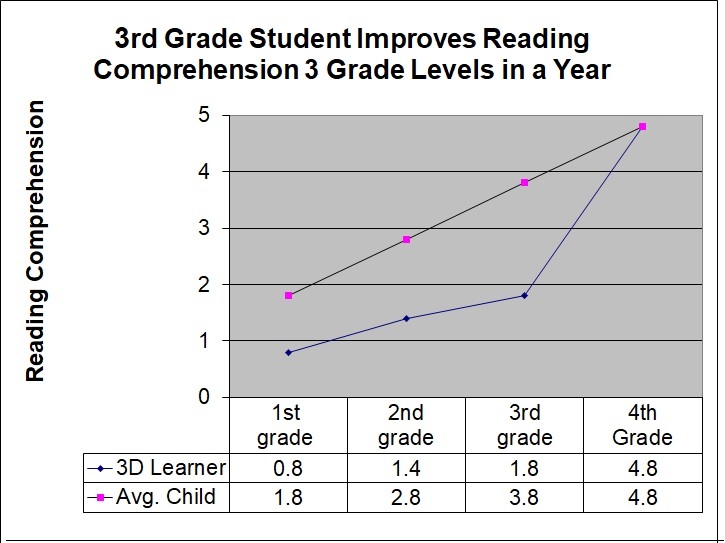
- A 3rd grader who improved his reading comprehension 3 grade levels in a year — and his teacher commented, “T made more progress in a year than any student I have had in 27 years of teaching”. M, Johnson, MD.
- A 3rd grader who made great strides academically and who improved his baseball skills so much that he was changed from the 9th batter to the 4th batter — within 3 weeks. Note, he had not knocked in a run in 2 years, and in the first three weeks he knocked in 6 runs.Our students:
- Are a lot smarter than present results would indicate
- Learn best when they see and experience information
- Have parents who really want to make the difference, and who embrace our concept of Success by Third Grade or Sooner
If this sounds like your child and you would like to discuss how you could put your child on their Pathway from Stress to Outrageous Success by Third Grade or Sooner, you can call us for a no cost conversation at 919-371-5295 or 561-361-7495 or click here to schedule a Stress to Success by Third Grade conversation.
Note, we want every child to succeed by third grade or sooner, we want our students to achieve Outrageous Success by Third Grade or Sooner

Visual-spatial learners learn best when they see and experience information. Many also have a combination of executive function challenges, visual processing issues, dyslexia and/or anxiety.
What differentiates 3D Learner is that we focus on the strengths of visual-spatial learners; we identify and address their challenges, and we help parents to be the coach and advocate their child needs. Our goal is to help our students to make significant gains in months.
We also recognize that visual-spatial learners are often capable of significant gains with the right program. The key is to both find the right program and do it at a time when your child can get the best results — and this can vary by family
Note, while most of our students learn differently, about a third have dyslexia. A great number have executive function, visual processing and anxiety challenges
If you are not sure if your child is a visual-spatial learner, download our no cost screening tool “is my child a visual-spatial learner”. Print out two copies. Complete one yourself and have your child answer the questions, too. Their answers may surprise you.
3D Learner recognizes each child is different. If you want to discuss your child’s situation, give us a call at either 919-371-5295 or click here to schedule a Stress to Success Conversation.
1. Will your program work for really smart or gifted students?
Yes, the program was developed for our really smart daughter and we have helped hundreds of really smart and gifted students succeed.
3 examples:
- One mom was told to send her son to a dyslexia school and to do one more dyslexia program. She asked if he knew of someone who taught the way her visual child learned and he recommended 3D Learner. Later, he became the valedictorian at a prestigious private school and graduated from Harvard.
Mom commented, “You changed his attitude and that was 90 percent of the battle” Kf, Boca Raton
- One mom was paying $25000 a year for a dyslexia school. She heard us speak and said, “That’s my kid you are describing”. The next year he was doing very well in a public school and the year after that, he was excelling in the gifted program
Five years later, she had a college account with well over $100,000 for her child, because she saved and invested the money she would have spent on the dyslexia school.
- One mom asked her daughter’s principal what she could do to help her bright daughter, whose reading comprehension was at the 48th percentile. He commented, “There is no need to do anything, someone has to be average”. Mom then was referred to us by a friend. With our help, her daughter improved her reading comprehension from the 48th to the 95th percentile, graduated high school in the top 7 percentile, and her daughter went from an introvert to an extrovert — improving self-esteem and confidence are part of what we do.
2. How is 3D Learner different from traditional tutoring or summer school?
For visual-spatial learners, 3D Learner provides an integrated, engaging and effective program.
Most programs focus on repetition, verbal instruction and a logical, sequential and auditory approach.
We have had parents who spent $5000, $10,000, $35000 and in one case $75000 on traditional tutors and dyslexia programs without success. We had the same experience with our daughter. For the visual-spatial learner with other challenges.
The 3D Learner Program ® teaches the way visual-spatial learners learn best—through seeing, doing, and experiencing—while also identifying and strengthening underlying skills like attention, processing speed, working memory, and visual processing. We also have a dyslexia component, where needed.
For parents, it is important to find the program that will work for your child.

The visual-spatial learner can benefit from an approach that teaches to their strengths, identifies and addresses their challenges and helps parents to be the coach and advocate your child needs.
3. Will this help if my child has dyslexia, ADHD, or executive function challenges?
Yes. Many visual-spatial learners have one or more of these challenges.
Instead of focusing only on labels, we address the root causes while leveraging your child’s strengths—often leading to gains in reading fluency, reading comprehension, attention, and confidence.
4. What kind of results can we realistically expect over the summer?
While every child is different, many families see:
- Noticeable improvement in reading and comprehension
- Increased focus and independence
- Greater confidence and willingness to learn
Summer is often when kids make their fastest gains—because there’s less school pressure and more consistency.
A few examples:
- Parents of a 3rd grader were told to find another private school. The student did our program, made significant progress over the summer and did very well the next year at the same school.
His teacher said, “T made more progress in a year than any student I had had in 27 years of teaching” M. Johnson, Md.
- Parents of a rising 5th grader had spent $34000 on an expensive dyslexia program. Our screening tools showed she was a visual-spatial learner with visual processing issues. With our help, she improved her reading comprehension 4 grade levels in 6 months, doubled her reading speed and decreased her homework time from 2.5 to 1.25 hours – while being able to do it independently.
- A rising 9th grader improved his reading comprehension 4 grade levels in less than 4 months, increased his reading speed from 200 to 360 words per minute and became an A student.

5. My child is bright but struggles—are they a good fit?
That’s exactly who this program is designed for.
If your child is smart but underperforming, avoids reading, struggles with attention, or seems inconsistent—they are often a visual-spatial learner who simply hasn’t been taught in a way that fits how they learn.
6. How much time does the program require each week?
At 3D Learner, we offer several different options:
- A hybrid model — where a student:
- Does a live program — often for 4 hours a day for 3, 4 or 5 days
- The balance of the program online
- The whole program online – for two or three hours a week
7. What role do parents play in the program?
In most programs, parents do not play a pivotal role — and receive very little training.
At 3D Learner, parents are a key part of the success.
You’ll learn how to become a transformational, strength-based parent—so you can confidently guide, support, and advocate for your child long after the program ends. At 3D Learner, we consider parent training an integral part of our program.
8. Why is starting this spring or summer so important?
Waiting often widens the gap.
Summer is a powerful window to:
- Close skill gaps quickly
- Prevent the “summer slide”
- Start the next school year with momentum and confidence
For many families, this is where the trajectory finally changes.
9. Is it better to do a spring or summer program?
The honest answer?
It depends on your child and your schedule.
A Spring Program May Be Best If:
- Your child is struggling right now and needs immediate support
- You want to see the best possible results before the next school year
- Confidence is dropping during the school year
- Testing or school decisions are approaching
- Your summer schedule will not allow the time to do a program
- It may favorably impact their ability to get in or stay in the school you want them in.
A Summer Program May Be Best If:
- You want uninterrupted, intensive progress
- School-year stress is too high
- You prefer concentrated skill-building without homework pressure
- You want your child starting next school year stronger and more confident
Both options can produce meaningful gains.
The key is choosing what works best for your child and your family rhythm.
Especially for visual-spatial learners, it is important to pick a time that will work for your child and you
If you would like to discuss a spring or summer learning program for your child, give us a call at 919-371-5295 or 561-361-7495 or click here to schedule a Stress to Success Conversation.
Recent Comments