
Third grade retention and other grade retention notices often come out in May and June. In other cases, the parents are just made aware that their child has low test scores. In our experience, reading comprehension is often the key issue.
Accepting third grade retention, other grade retention or low test scores is not the best option. We strongly recommend seizing the opportunity to turn lemons into lemonade by improving your child’s reading comprehension.

3D Learner helps students beat third grade retention, other grade retention and low test scores with strength-based training to improve reading comprehension.
Improving Reading Comprehension — The Best Way to Beat Third Grade Retention, Other Grade Retention and Low Test Scores
While test anxiety can be a factor, low reading comprehension levels has been the key problem in virtually every case where third grade retention, grade retention and/or low test scores are present.
To Get It Right, we recommend the following:
- Reject grade retention or low test scores. Commit to significantly improving your child’s reading comprehension
- Identify several key factors:
- What is your child’s present level of reading comprehension? It is very helpful to both identify what their reading comprehension level is and for both parents to be on the same page.
- Is your child a bright right brain neurodivergent learner, who learns best when he or she sees and experiences information? Click here for our no cost “Is my child a bright right brain neurodivergent learner screening tool?” For more detail, go to our blog post on Is my child a right brain neurodivergent learner.
- Determine if there are other complicating factors that might include dyslexia, executive function, auditory or visual processing, anxiety, and other challenges.
- Seek help to both identify your child’s present level of reading comprehension, whether they are a right brain neurodivergent learner and what other issues are holding your child back.
One of our goals is to help every parent whose child may be facing third grade retention, grade retention, or low test scores. We also want to help parents to both assess for reading comprehension level and to identify the best possible way to help your child to improve his or her reading comprehension and test scores.
To have a no cost conversation, call us at 561-361-7495 or click here to schedule a time for a “How to Beat Third Grade Retention, Grade Retention or Low-Test Score by Improving Reading Comprehension Conversation”

We have helped thousands of bright right brain neurodivergent learners over the last 27 years. While they often came with labels, what is often missed are their strengths. Our students are often:
- Right brain learners who learn best when they see and experience information
- Neurodivergent learners as compared to their neurotypical peers, who are logical, sequential and auditory learners. The neurodivergent learner often solves problems in unique ways and cannot always explain how they got there.
- Kids who learn from whole to part, but they are often taught part to whole
- Hard to understand. They are often much smarter than present results would indicate, but they learn differently and may have dyslexia, executive function challenges, visual processing issues and/or anxiety challenges.
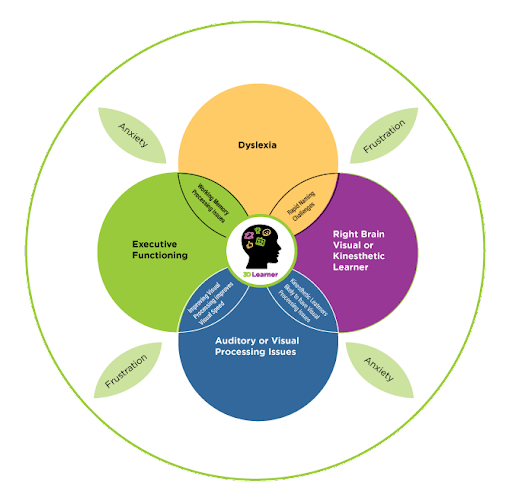
Many smart struggling students learn differently and have a combination of dyslexia,
executive function, and/or auditory and visual processing challenges
- Capable of making significant gains in months, with the right help
- Dependent on their parents to find the solution that will help them succeed
Parents often share that their child has been diagnosed with dyslexia, a learning disability, ADHD, or Executive Function and/or anxiety challenges. Or they might say your child is just lazy and unmotivated. Even worse, too often parents are told their child has limited potential.
How We Learned Our Child Was a Right Brain Neurodivergent Learner
In our case, they told us at a transition meeting in 8th grade, “Your daughter is not college material because her reading comprehension is 3 years below grade level. We recommend putting her on a vocational track for high school, so she can get a job when she graduates”
This was after years of several dyslexia treatments, intensive reading programs and many hours of at home help, with me. I had my Masters in Education, years of experience, but I was at a loss”, said Mira Halpert, her frustrated mother. Mark, her father, asked Julie what she wanted to be when she grew up and Julie answered, “The teacher I never had”. It was at this moment I became “A Mom on a Mission”.
“Then I discovered that while her prior diagnosis was technically correct, they missed that she was a bright right brain neurodivergent learner, who could do far better with a hands-on experiential program that leveraged her strengths. With the 3D Learner Program I developed, our daughter improved her reading comprehension 4.2 grade levels in 7 months, went on to earn her college degree and Master’s in Education from the University of Florida and she is completing her 20th year as “The Teacher She Never Had””.
Note, after helping thousands of bright right brain neurodivergent learners, I realize that parents can make the difference if they:
- Screen to see if their child is a right brain neurodivergent learner. If your child is a right brain neurodivergent learner, it may change how you parent this child, what you believe is possible and who you partner with.
- Realize that their bright right brain neurodivergent learner can either:
- Struggle for years as no one leverages their strengths
- Be much more successful within months
- Assess for other co-existing conditions
- Engage in a conversation on how they can make the difference
Is your child a right brain neurodivergent child?
- Does your child remember places visited even from years ago?
- Does your child learn best when they see and experience information?
- Is your child a lot smarter than present results would indicate?
Click here to download our ‘Is your child a right brain neurodivergent learner screening tool?”.
If you have a neurodivergent, right brain or kinesthetic learner and want to have a conversation, call us at 561-361-7495 or click here to schedule a Let’s Discuss Creating a Pathway to Success for Your Child.
3D Learner Helps The Right Brain Neurodivergent Learner to Make Significant Gain in Months
3D Learner offers a tailored, integrated, engaging and effective option that has helped thousands of neurodivergent, right brain and kinesthetic learners from 46 states and 13 other countries.
As Dr. Linda Silverman, the Director of the Gifted Development Center in Denver Colorado said:
”Your program is what many gifted students who learn differently need. I recommend many of the components you use, but you are the first professionals who have so effectively integrated them with your very unique and effective learning system.”
3D Learner Options
3D Learner offers parents several unique options, including:
- Coming for a one-week intensive program followed up with 10 hours via zoom. We have had students come from California, New York, Texas and many other states — as well as hosting students from 13 other countries.
- For students who live closer, but not close to our Durham NC office, students have come for 3 days of intensive training, followed up with 2 days of intensive training 4 to 8 weeks later. We then can do the appropriate follow-up via zoom.
- We have traveled to other places to do training for multiple clients – with Singapore being the place we traveled the furthest.
- We have also helped students solely via zoom – -which works well for some students – although we do prefer a live option. Note, for the very busy parents where travel is not an option, our program may be far better than local options.
If you have a neurodivergent, right brain or kinesthetic learner and want to discuss the options, call us at 561-361-7495 or click here to schedule a Let’s Discuss Creating a Pathway to Success for Your Child.
Note, we have had students make dramatic gains including:
- A third grader improved his comprehension 3 grade levels in a year and his teacher commented, “He made greater gains than any student I have had in 27 years of teaching”.
- A rising 5th grader from Texas who improved her reading comprehension by 4 grade levels in 6 months, while doubling her reading speed and cutting homework time in half.
- A 7th grader from the State of Washington improved his reading comprehension by 3 grade levels in 5 months and made great strides in all his subjects.
- A student from St Petersburg, FL, went from being a C- student to an A student and her ulcer disappeared.
If you have a neurodivergent, right brain or kinesthetic learner and want to discuss the options, call us at 561-361-7495 or click here to schedule a Let’s Discuss Creating a Pathway to Success for Your Child.

If you have a smart struggling child, you may be asking yourself, “Should we invest in a summer program for our child?” Our specialty is the student who is a lot smarter than present results would indicate and is what we call a bright right brain learner – who learns best when they see and experience information.
The simple answer is yes, if:
- Your child is a lot smarter than present results would indicate?
- You have the time and resources to do the right program.
- You find the right program that can help your child to make significant gains in months in multiple areas (e.g. reading fluency, reading comprehension, attention, confidence …)
- You get the help needed to be the coach and advocate your child needs
Is 3D Learner The Right Summer Program for Your Child?
If you have a smart struggling child, they may have been identified with dyslexia, ADHD, executive function or related challenges. We have found that most smart struggling students:
- Are a bright right brain learner
- Often have a sea of strengths and challenges
- Can do far better when one focuses on their strengths, while addressing their challenges
- Can benefit from the right summer program, when school pressure is not present
As we look back over the last 27 years, we notice that a significant number of students we helped over the summer made significant gains in their reading fluency, reading comprehension, math skills, attention and self-confidence.
What were the key actions that led to our student’s success:
– Their parents called us and had a conversation.
– Their parents then invested in our Comprehensive Assessment that in each case showed their child learned differently, had significant strengths and challenges, and had the potential to do far better with what we offered.
– We discussed how what we offered could be far more effective than virtually any other program because:
-
- We teach the way their child learns
- We tailor our program to meet each child’s needs
- We engage our students by both focusing on what is important to them and by using our hands-on methods, that are integrated, engaging and effective
- We address the relevant attention, visual processing working memory and/or processing speed issues that are often present as well as address phonemic awareness
- Our approach improves decoding, reading fluency, and reading comprehension. We strive to ignite a love for learning and reading!
- While we help students with dyslexia, ADHD, executive function and related issues, we use the positive label of a Bright Right Brain Learner.
- We help parents to be the coach and advocate their child needs. NOTE: we offer one of the few programs that has parent coaching as an integral part of the program.
– The parents recognized that we could tailor a program to meet their child’s needs, help them to be the coach and advocate their child needed, and had a high probability of generating significant results within months.
– Their parents chose to work with us
What did our most successful parents do that led to truly outstanding progress? They
- Leveraged our intensive program that laid the groundwork for significant gains – note, in the last few years as we leverage zoom, we have been able to help students via zoom, too.
- Did the follow-up over the next few months to generate the maximum benefit from our joint efforts
Their child then made gains like the three cases outlined below:
One mom of a third grader was really frustrated. Despite investing in other programs, her bright 3rd grader was really struggling. 5 minutes into the initial call, she commented, “How is it that after 5 minutes you appear to know my child better than people who have known him for years”. She had been told to find another private school for her son, whose reading comprehension was 2 years below grade level,
She lived out of state and asked, “What is the best way to do your program”. We responded that while we offer a 5-day intensive program, we have seen excellent results with students who came for 3 days (for 2 to 4 hours, depending on the age of the student) and then another 2 days 4 to 6 weeks later. That is what she chose to do. Her son was able to improve his reading comprehension 3 grade levels over the next year, to excel at his school.
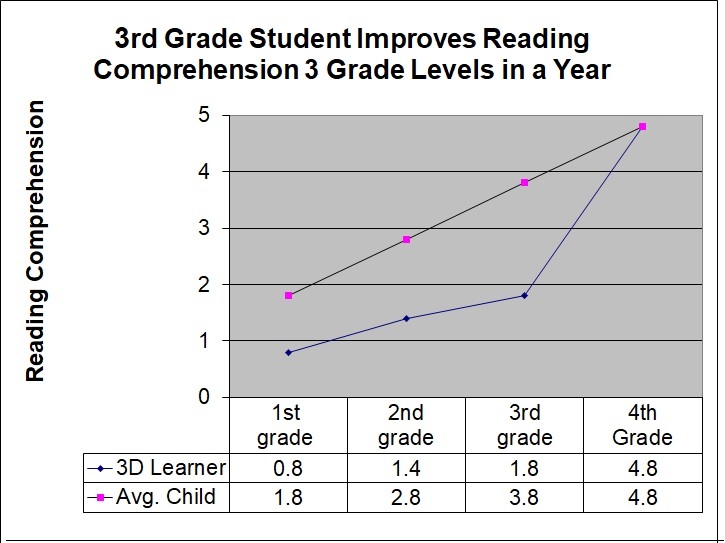
His teacher said “I have never seen a student make such dramatic gains in 27 years of teaching
For students who have come to us from California, Washington, Arizona and other states that are further away, a one-week intensive program is often more practical.
A rising 6th grader was really struggling with attention, self-control and reading comprehension. He was also struggling with baseball where his average had dropped to 260, as the pitching became harder to hit. As we spoke with him, we discussed how our program could help his baseball skills, as well as his attention, self-control and reading comprehension. Sports, dance, or martial arts are often what our students want to improve. By working on their neural timing and their visual processing, we are often able to engage the students and help them to dramatically improve their performance in sports and other activities.
With our help, he was able to:
- Improve his reading comprehension 4 grade levels in 5 months
- Double his reading speed
- Go from special education classes to regular education classes
- Be far more attention and control his impulses
- Increase his batting average from 260 to 382 and increase his home run production from 1 to 10
- Become much more confident in his abilities
A rising 9th grader who was a C+ student, his reading comprehension was 4 years below grade level, he was reading at 200 words per minute and was considered unmotivated. In our initial conversation, mom was delighted to hear that we would leverage her child’s strengths. With our work with the student and his parents he was able to:
- Improve his reading comprehension 4 grade levels in 100 days – from the 5th to 9th grade level
- Increase his reading speed from 200 to 360 words per minute
- Become a highly motivated student
- Excel in high school and get several full scholarship offers for college
Our program was developed to do this for our high school daughter. We realize our goal is to both motivate, train and support our students. We get student buy-in before we accept teenage students.

Both the Family Empowerment Scholarship (FES- UA) and the Personalized Education Program vouchers are designed to help private school and homeschool students.
Private school parents can often use the vouchers towards tuition or to improve their child’s academic skills.
Homeschool parents often use the vouchers to improve their child’s academic performance.
Note, many private schools and homeschool students are what we call neurodivergent right brain learners.
At 3D Learner, we help the neurodivergent right brain learner to improve their academic, executive function and related skills.
We define neurodivergent right brain learners as students who:
- Learn differently – sometimes called neurodivergent, visual, kinesthetic or right brain learners. These students learn best when they see and experience information.
- May have dyslexia, dyscalculia or a learning disability,
- May have ADHD.
- May be on the autism spectrum – especially intelligent students with Aspergers.
- Are often smart enough to succeed but lack some key skills.
In this blog post we will discuss three other ways to leverage both the Family Empowerment Scholarship (FES- UA) and the Personalized Education Program vouchers.
1- Some homeschool parents want their child to enter private or public schools in the fall. The challenge is their child may be struggling with reading comprehension, math, attention, executive function and/or anxiety challenges. 3D Learner addresses all these issues and more. The May – August time frame is an excellent time to close the gap.
2- A few parents realize their child is too far behind and use the Family Empowerment Scholarship (FES- UA) and the Personalized Education Program vouchers to close significant gaps utilizing a gap year. This has helped three students to make much more significant gains this year, than they would have made with traditional schooling.
3- Some states offer significant scholarships for students who meet the GPA (Grade Point Average) or SAT – ACT requirements. The Family Empowerment Scholarship (FES- UA) and the Personalized Education Program vouchers can be used to significantly improve SAT – ACT scores. This allows students to both earn a scholarship that may be worth $20,000 to $29,000 over four years and to get into better colleges or universities. You can read more about this on our blog post in the Bright Futures Scholarship.
If you would like to discuss how we might help your neurotypical, neurodivergent and right brain learners leveraging the Family Empowerment Scholarship or Personalized Education Program vouchers, call 3D Learner at 561-361-7495 or book a time on our schedule at Let’s discuss the Florida Empowerment Scholarship – Unique Abilities or Personalized Education Program vouchers.
.
Students today are often struggling with reading fluency, reading comprehension and/or math.
Three of the greatest educational risks are:
- Parents often do not know what their child’s present level of reading fluency, reading comprehension and math skills are at
- Students who learn differently (i.e. neurodivergent, right brain and kinesthetic learners) often fall behind — as neither school based or home school curriculum may be consistent with how they learn best
- Without testing, parents may not be aware of how their child learns best, where their child is strong and where their child struggles
The opportunities for parents include:
- There are real benefits with an assessment that shows you::
- How your child learns best
- What are your child’s strengths and challenges
- What is your child’s present level of performance for reading fluency, reading comprehension and math
- If needed, the assessment can help educators to tailor a program to:
- Capitalize on how your child learns best
- Improve their reading speed, reading comprehension and math skills
- Help you to be the coach your child needs
- How you can help your child be all they can be
How 3D Learner Assesses for Success
Mary called and was not sure about her child’s reading fluency, reading comprehension and math skills were at. She had tried two years of dyslexia treatments. Mary was not interested in labeling, but she was very interested in knowing:
- How her daughter learned best
- What her daughter’s strengths and challenges were
- What was her child’s present level of reading comprehension, reading fluency and math
- If there were significant gaps, could we help her daughter get to grade level or above
- Whether what we offered could improve her child’s baseball and soccer skills. Mary knew that her daughter would be even more interested in help, if it could make her better at baseball or soccer.
Mary shared a few of her frustrations, that included, her daughter:
- Understood stories when Mary read them to her, but struggled with silent reading comprehension
- Read more fluently, but often had difficulty remembering words she had seen and not mastered
- Was good at math, but was now struggling with math word problems.
We then asked Mary what her daughter was good at, Mary shared that her daughter:
- Had an excellent memory for things she had seen and experienced
- Was a good person — who loved playing with younger kids and cared about seniors
- Was good at baseball and soccer but was inconsistent. Three area of concern were:
- Her daughter would sometimes lose focus during a game
- In baseball, she would sometimes hit the ball well, but too often she would pull the ball foul
- In soccer, her shots often went to the right side of the goalie
- Her daughter was frustrated that she was not doing as well as she wanted to
We shared this infographic with Mary and explained how we assess for how the student learns best and whether they have a visual processing, executive function, dyslexia and/or anxiety challenge.
- Many smart struggling kids learn differently. They are often a neurodivergent, right brain or kinesthetic learner, who learn best when they see and experience information. This is important to know, because if they learn differently, it alters the way you teach them, the curriculum you may choose, how you parents them and how one coaches them in sports.
- 74% of the students we see have a visual processing issue – they may see the whole field or the whole room, but their eyes have difficulty converging. This often results in their skipping words and/or liens when reading and having difficulty catching a ball.
- The executive function challenges we often see may include:
- Difficulty sustaining attention and either being hyperactive or impulsive. When we assess a student with the Interactive Metronome ®, we often see that a student’s body moves faster than their brain. In sports, this results in hitting the ball too early. In baseball that would explain pulling it foul or for a right footed kicker, hitting the soccer ball to the right of the goalie. In life, the attention issues may results in a child losing focus when doing work or during a game
- The working memory assessment often shows a student has an excellent visual memory, but has difficulty remembering what they have heard or read
- The Dyslexia Assessment shows where a child is strong and where they struggle. We can assess for Dyslexia and we can also tailor a program that focuses on the key issues
- The reading comprehension assessment shows two different challenges:
- A number of students are below grade level
- Some students are at grade level, but the assessment shows they should and could be well above grade level
- Our math assessment shows us where a student is at and where they struggle
- The anxiety assessment often shows the student gets very anxious in certain situations
Mary asked about the tools we use and whether it is different from what schools and psychologists assess for. We shared that:
- The key assessment tool we use is the Structure of Intellect Assessment ® that shows how a student learns best, where they are strong and where they struggle.
Comments from a principal, a special educator and a psychologist
- A principal asked a special educator why their public school stopped using this assessment. The special educator said “We are required to find a disability in order to provide services. This assessment does not do that. 3D Learner has the luxury of focusing on tailoring a program to help a student succeed
- A psychologist commented, “I wish we could shift our focus from labeling to how to help a child succeed”
- The Visagraph ® we use to show if there is an eye tracking issue can show both the initial challenge and can be used post training to show the results Here is a video that shows a student’s eye tracking before and after training. He commented,. “I now enjoy reading and do much more of it”
- We use the Mindprint Assessment ® developed by by the University of Pennsylvania to assess executive function skills
- We use a Woodcock Johnson ® Reading Comprehensive Assessment
- We use the Core Dyslexia Assessment ® developed by the University of Florida to assess phonics, phonemic awareness and reading fluency. It also helps us to see if the child has dyslexia,
- We use the Perceptions Math Assessment ®
- We use Heartmath ® to assess for anxiety
When we assessed Mary’s daughter we did find that:
- She was a neurodivergent, right brain or kinesthetic learner who learns best when she sees and experiences information
- Her daughter had a number of skills that were well above grade level, but struggled with a few key skills
- She did have a significant visual processing issue
- Attention was an issue and her daughter’s body was racing faster than her mind This explained some of the self-control and sports related issues
- Her visual memory was excellent, but her auditory memory was weak
- She no longer has significant issues related to reading fluency, but there were some areas where she could benefit from additional training
- Her reading comprehension was a year below grade level
- Arithmetic was not an issue, but that word problems were
- Anxiety was an issue
Mary has the flexibility to prioritize training and her daughter was able to make significant gains over the next six months in reading comprehension, math, attention, visual processing, and self-esteem. Her baseball and soccer skills improved too. Mary commented that knowing my daughter was a neurodivergent learner with visual processing and executive function challenges changed everything, and addressing the whole child changed her life. She also added that by helping to improve my daughter’s baseball and soccer skills, you engaged her in the process.
If you would like to discuss your child’s situation and learn more about how we Assess for Success, you can call us at 561-361-7495 or click here to schedule an Assess for Success Conversation. Note, these assessments can be done in person or via zoom.
Recent Comments