
Elementary School Success for Smart and Gifted Kids Who Learn Differently
Since 1997, 3D Learner has helped smart and gifted students who learn differently achieve Elementary School Success. We call these students visual-spatial learners. They learn best when they see and experience information and often think in 3D. They are often very smart, many are gifted and they often underperform because they are not taught to their strengths. 3D Learner has helped thousands of students from all over the country — mostly from our South Florida location. We have now moved to Durham, NC.
Our focus now is to connect with local parents and parents nationwide, to share valuable information, and to have conversations with parents that focus on understanding: your challenges, what you have tried, what your fears and frustrations are, what you would most like for your child and yourself and to share no cost tips on how we can help.
Our focus is on elementary school success for smart and gifted kids who learn differently. FYI, we are also planning on using the input we get to develop an Elementary School Success with Transformational Strength-based Parenting Program that will be engaging, informative and be designed to yield transformational results for your child and you.
If you would like to have an Elementary School Success Conversation
call 3D Learner at 919-371-5295 or
click here to schedule a no cost Elementary School Success Conversation.

Elementary School Success with Transformational Strength-based Parenting.
Want to Understand the 3D Learner Approach First?
Elementary School Success Through Transformational Strength-Based Parenting
Especially for parents of smart and gifted visual-spatial learners
Starting Wednesday October 28th at 8 pm, 3D Learner will be hosting 3 webinars to help parents understand the risks facing your child, the potential your child may have to be far more successful with a strength-based approach and how you, the parents, can make the difference.
We will discuss how to recognize your child’s strengths, understand their struggles and support more successful learning at school and at home.
Across the three-part series, we’ll explore:
- Understanding your child: Recognize visual-spatial strengths and consider what they mean for your child and you.
- Identify and Addressing challenges: Understand how reading, attention, anxiety and self-regulation can affect schoolwork and homework.
- Helping parents make the difference: Explore practical ways to coach, advocate and support greater confidence and independence.
Begins: Wednesday, October 28, at 8 p.m. Eastern
Format: Three live Wednesday-evening webinars
Cost: No cost
Replays: Available to everyone who registers
Complete the form below to register for the series.
What Progress Has Looked Like for Other Families
Every child’s starting point and progress are different. These examples show what individual families have experienced.
From a discouraging prediction to growing confidence
One kindergarten family had been told their son would need special education for years. His mother felt understood during their first conversation with us. After working with 3D Learner, her son entered first grade near the top of his class, later earned reading awards and showed a substantial improvement in self-esteem.
Stronger comprehension—and a different school experience
The parents of a third grader had been advised to find another school because of his comprehension difficulties. With our help, his measured reading comprehension improved by three grade levels in less than a year. His teacher reported he made more significant gains than any student she had had in 27 years of teaching
Shorter homework evenings and greater independence
Another mother came to us after spending $34,000 on a dyslexia program while her daughter continued to struggle with comprehension, anxiety and homework lasting more than two and a half hours a night.
With our help, the family reported a four-grade-level improvement in reading comprehension over six months, doubled her reading speed and cut homework time in half. The mother’s direct involvement fell from roughly two and a half hours to 10–15 minutes.
A 5th grader with an ulcer and a C average improved to an A student, her doctor could not find her ulcer and she became a confident outgoing and very successful student
These are individual outcomes, not promises of a particular result or timeline.
Curious Whether Your Child Has Visual-Spatial Learner Strengths?
Our “Is My Child a Visual-Spatial Learner?” screening tool can help you notice patterns in how your child learns.
Use it as a starting point for understanding and conversation. It is not a diagnosis or a substitute for a professional assessment.
Download the Is my child a Visual-Spatial Learner Screening Tool
3D Learner Approach
We help students improve their reading, comprehension, attention, confidence and self-regulation. We help parents to be the coach and advocate your child needs. Our program was born after our 8th grade daughter was told she was not college material. Today, she has her Doctorate in Education from the University of Florida. Our son is now an entrepreneur helping college and professional athletes improve their performance. Mira Halpert, M.Ed., has her Master in Teaching the Gifted from the University of Michigan and is committed to helping visual-spatial learners succeed.
Our approach—Transformational Strength-Based Parenting—approach can help you to:
1. Recognize and use your child’s strengths
Discover what engages your child who learns differently and how to make learning more meaningful.
2. Understand and address their obstacles
Look beyond “try harder” to identify the challenges behind difficult schoolwork, lengthy homework and frustration. While we are strength-based, we believe it is important to identify and address their challenges.
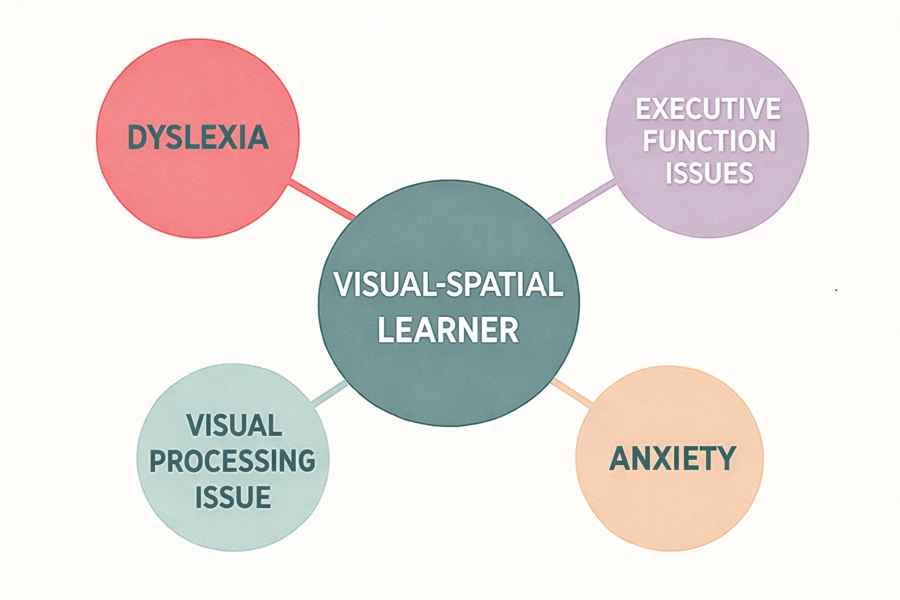
Many of our students are visual-spatial learners, who learn best when they see and experience information. A term coined by Dr. Linda Silverman, founder and director of the Gifted Development Center in Denver.
3. Become a more effective coach and advocate
Learn practical ways to support progress, encourage independence and communicate your child’s needs.
As educators, parent advocates and parents who have navigated learning challenges with our own children and thousands of others, we understand how personal this journey can be.
What May Trigger You to Connect
You see your child’s curiosity, creativity and potential. Yet reading comprehension, math word problems or homework may tell a very different story.
Perhaps your child understands a concept when you show them—but struggles to explain it on a test. Homework takes over your evenings. Confidence is slipping. You may have tried tutoring or other programs and still wonder: What are we missing?
Two Ways to Learn More About Your Child and How You Can Make The Difference
1- Sign up for our 3 part webinar series on Elementary School Success with Transformational Strength-based Parenting starting Wednesday October 28th at 8 pm.
Complete the form below to register for the series.
2- Engage in an Elementary School Success Conversation. Either